


Analysis of Metals in Drinking Water
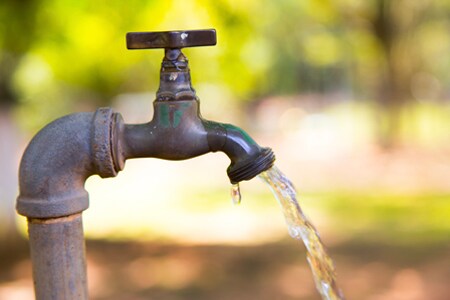
Metals can leach into drinking water supplies from natural mineral deposits, or various industrial activity. Additionally, heavy metals, such as lead, and leach into tap water from household plumbing and service lines. The USEPA has established MCLs for toxic metals, and SMCLs for metals that affect the aesthetic qualities of water. These metals are determined by various technologies including Atomic Absorption, ICP-AES, and ICP-MS depending on the concentration. Except in cases where only a few elements will be analyzed, we recommend ICP-AES and ICP-MS for analysis of metals in drinking water. Currently, ICP-AES and ICP-MS are both required due to EPA regulations and lack of sufficient sensitivity of ICP-AES to analyze all metals to drinking water MCLs.
Featured Applications
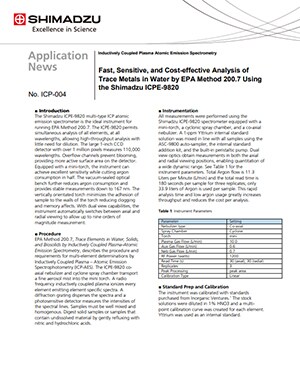
Fast, Sensitive, and Cost-effective Analysis of Trace Metals in Water by EPA Method 200.7 Using the Shimadzu ICPE-9820
The Shimadzu ICPE-9820 multi-type ICP atomic emission spectrometer is the ideal instrument for running EPA Method 200.7. The ICPE-9820 permits simultaneous analysis of all elements, at all wavelengths, allowing high-throughput analysis with little need for dilution. The large 1-inch CCD detector with over 1 million pixels measures 110,000 wavelengths. Overflow channels prevent blooming, providing more active surface area on the detector. Equipped with a mini-torch, the instrument can achieve excellent sensitivity while cutting argon consumption in half. The vacuum-sealed optical bench further reduces argon consumption and provides stable measurements down to 167 nm. The vertically orientated torch minimizes the adhesion of sample to the walls of the torch reducing clogging and memory affects. With dual view capabilities, the instrument automatically switches between axial and radial viewing to allow up to nine orders of magnitude measurement.
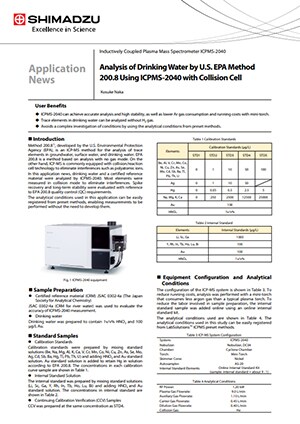
Analysis of Drinking Water by U.S. EPA Method 200.8 Using ICPMS-2040 with Collision Cell
Method 200.8), developed by the U.S. Environmental Protection Agency (EPA), is an ICP-MS method for the analysis of trace elements in groundwater, surface water, and drinking water. EPA 200.8 is a method based on analysis with no gas mode. On the other hand, ICP-MS is commonly equipped with collision/reaction cell technology to eliminate interferences such as polyatomic ions. In this application news, drinking water and a certified reference material were analyzed by ICPMS-2040. Most elements were measured in collision mode to eliminate interferences. Spike recovery and long-term stability were evaluated with reference to EPA 200.8 quality control (QC) requirements. The analytical conditions used in this application can be easily registered from preset methods, enabling measurements to be performed without the need to develop them.
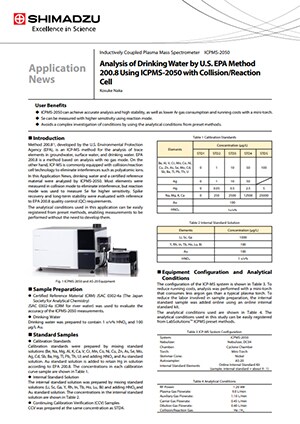
Analysis of Drinking Water by U.S. EPA Method 200.8 Using ICPMS-2050 with Collision/Reaction Cell
Method 200.8), developed by the U.S. Environmental Protection Agency (EPA), is an ICP-MS method for the analysis of trace elements in groundwater, surface water, and drinking water. EPA 200.8 is a method based on analysis with no gas mode. On the other hand, ICP-MS is commonly equipped with collision/reaction cell technology to eliminate interferences such as polyatomic ions. In this Application News, drinking water and a certified reference material were analyzed by ICPMS-2050. Most elements were measured in collision mode to eliminate interference, but reaction mode was used to measure Se for higher sensitivity. Spike recovery and long-term stability were evaluated with reference to EPA 200.8 quality control (QC) requirements. The analytical conditions used in this application can be easily registered from preset methods, enabling measurements to be performed without the need to develop them.
EPA Method 200.8 Using Shimadzu ICPMS-2040
EPA Method 200.8, adopted in 1994, is a widely used analytical method for the determination of a variety of trace elements in waters and wastes using inductively coupled plasma mass spectrometry (ICP-MS). It covers a range of analytes and is commonly used for environmental analysis due to the high sensitivity of ICP-MS instruments coupled with the relatively high sample throughput on samples requiring analysis of multiple elements. Along with EPA Method 200.7 (for ICP-OES) and 200.9 (for Atomic Absorption or AA), these methods are among the most commonly used and cited methods for metals in water testing. A comparison of the analytes prescribed in each method is given in Table 1. Although many of the analytes are cross-listed for two or more methods, each method stands alone in regards to the total suite of elements analyzed, instrumentation, and sample QA/QC parameters. The purpose of this document is to provide guidance on how to set up EPA Method 200.8 for metals in water on the ICPMS-2040. This document is to be used in conjunction with, and is not a substitute for, the method documentation published by the EPA nor an individual laboratory’s SOP.

Analysis of Trace Elements in Water by EPA Method 200.8 Using the Shimadzu ICPMS-2030
This application note describes the methodology and use of the Shimadzu ICPMS-2030 inductively coupled plasma mass spectrometer for the analysis of trace elements in drinking and fresh waters following the EPA 200.8 method. This method is also used for analysis of wastewater. The newly developed collision cell in ICPMS-2030 is generally used to remove polyatomic interferences with helium gas. Because a collision cell is not currently adapted in the EPA 200.8 method, correction equations alternatively were used to minimize the effect. Here, we demonstrate the stability and sensitivity of the ICPMS-2030 for EPA 200.8 analyses.
Related Products
Inductively Coupled Plasma Mass Spectrometer
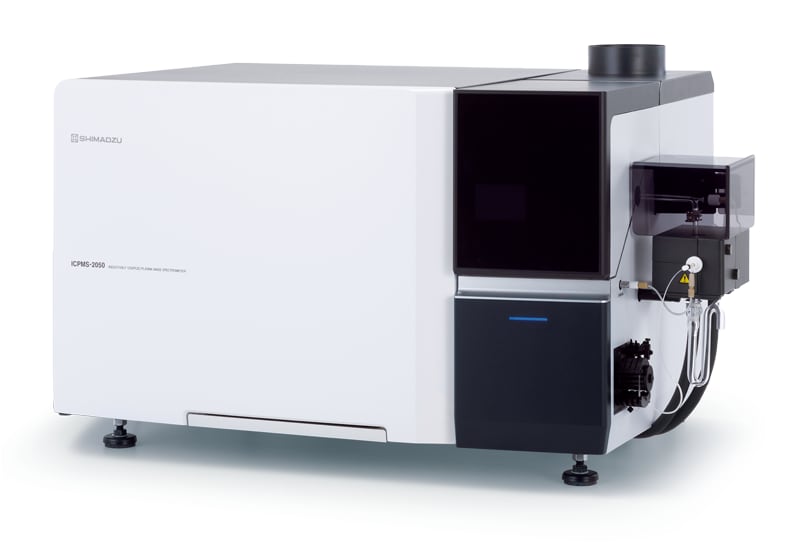
Shimadzu’s ICPMS-2040 Series / 2050 Series of ICP Mass Spectrometers; Use ICP-MS if you need low concentrations of multiple trace metals in a lot of samples. Shimadzu’s ICPMS-2040/2050 Series operators can analyze masses at 0.5 amu intervals using the high-resolution mode, enabling half-mass correction for doubly charged interferences common in rare earth elements (REEs). In addition, to the inter-element correction (IEC) function can correct for interferences the ICPMS 2040 and 2050 include collision cell technology to remove polyatomic interference. The ICPMS 2050 adds a reaction cell for improved interference removal for elements such as As and Se.
ICP Atomic Emission Spectrometer
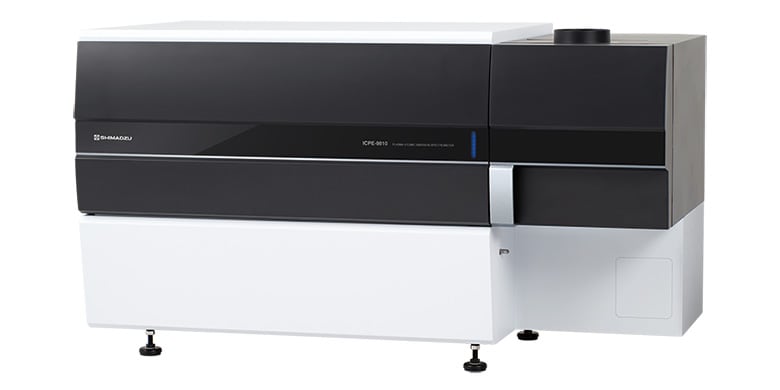
Shimadzu's ICPE-9800 Series measures multiple elements in ppb to ppm levels accurately and quickly with low analysis costs. Use ICP-AES for trace metals where the lowest concentrations are not needed and you need to run multiple elements in a lot of samples.
Atomic Absorption Spectrophotometer
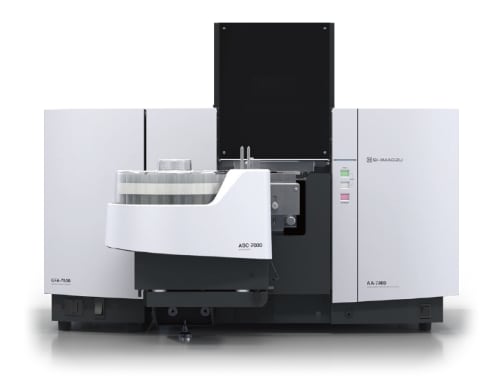
Use atomic absorption methods if you have need for only a few metals and not a lot of samples per day. atomic absorption is also useful for determinations of low concentrations of metals using electrothermal atomization or low concentrations of As and Se or Hg using hydride generation or cold vapor techniques respectively.