


Analysis of Mixed Polymer Sample as Microplastics using Pyrolysis GC/MS
The Fourier transform infrared spectrometer (FTIR) is used in qualitative analysis of comparatively large MPs, while the FTIR microscope employing an infrared microscope is mainly used for MPs less than 212 µm which cannot be readily removed with tweezers and analyzed by the attenuated total reflectance (ATR) method of FTIR. The FTIR microscope enables highly sensitive analysis of fine MPs with a size of approximately 20 μm. Additionally, IR methods provide counts per volume, but do not provide the concentration of MP in a mass per volume basis.
Pyrolysis gas chromatography/mass spectrometry (Py-GC/MS) using ASTM D8401 is an effective method for the qualitative and quantitative analysis of individual polymers contained in mixed samples providing highly sensitive detection of the distinctive pyrolysis products of each polymer.
| Polymer | Pyrolysis product |
|---|---|
| PE | C20, alkane C20, α-alkene C20, α, w-alkene |
| PP | 2,4-dimethylhept-1-ene 2,4,6,8-tetramethyl-1-undecene 2,4,6,8-tetramethyl-1-undecene 2,4,6,8-tetramethyl-1-undecene |
| PS | Styrene 3-butene-1,3-diyldibenzene 5-hexene-1,3,5-triyltribenzene |
| PVC | Benzene 1-Chloroindan Dihydronaphthalene Azulene |
Table 1 Pyrolysis Products and Analytical Conditions Used in Detection of Polymers
Fig. 1 shows the SIM chromatograms of the pyrolysis products of PE. By tracing the distinctive pyrolysis products of the respective polymers, the contents of the polymers could be specified accurately, even multiple polymers were intermixed in a sample.
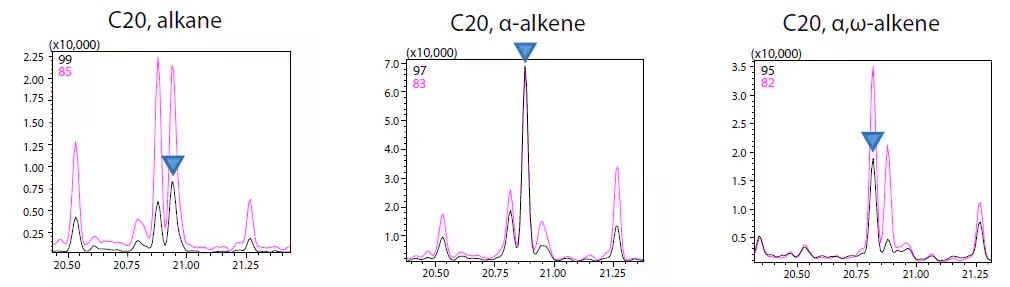
Fig. 1 SIM Chromatograms of Pyrolysis Products of PE in Mixed Polymer Sample
Related Applications
Related Product
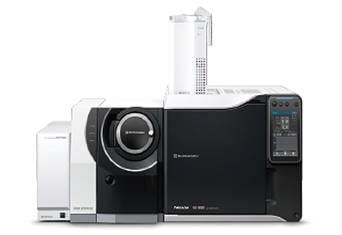
Py-GC/MS System Gas Chromatograph Mass Spectrometer
Pyrolysis gas chromatography–mass spectrometry (Py-GC/MS) is a powerful technique for characterizing a wide range of materials, including those that are insoluble, complex, or present at trace levels. Often requiring little to no sample preparation, it is particularly effective for analyzing substances such as polymers, microplastics, rubber, paints, dyes, resins, coatings, cellulose, wood, textiles, and oils. By applying heat to break down samples, Py-GC/MS enables the analysis of compounds that are otherwise unsuitable for conventional gas chromatography–mass spectrometry (GC/MS).