


AGX-V2 Series Precision Universal Tester - Applications
AUTOGRAPH Precision Universal Tester

Most of the documents on the LITERATURE is available in PDF format. You will need Adobe Acrobat Reader to open and read PDF documents. If you do not already have Acrobat Reader, you can download it free at the Adobe's Website. Click the GET ADOBE READER icon on the left to download a free copy of Adobe Acrobat Reader.
Application Areas
The AGX-V2 is a high-performance universal testing system designed to support advanced tensile, compression, flexural, peel, shear, and fracture testing applications. Its versatility makes it a preferred solution for laboratories working with metals, plastics, composites, adhesives, textiles, and construction materials.
Common Applications
- Tensile testing of plastics and films
- Compression testing of plastics and concrete
- Flexural testing of polymers and composites
- Metal tensile and fracture toughness testing
- Peel and adhesion testing
- Textile strength and elongation testing
Supported ASTM Methods (Including but Not Restricting To)
Plastics
- ASTM D638 - Tensile Properties of Plastics
- ASTM D790 - Flexural Properties of Plastics
- ASTM D6272 - Four-Point Flexural Testing
- ASTM D695 - Compressive Properties of Rigid Plastics
- ASTM D882 - Tensile Properties of Thin Plastic Sheeting
- ASTM D1894 - Coefficient of Friction Testing
Metals
- ASTM E8 - Tension Testing of Metallic Materials
- ASTM A370 - Mechanical Testing of Steel Products
- ASTM A416 - Prestressed Steel Strand Testing
- ASTM A48 - Gray Iron Castings
- ASTM E399 - Fracture Toughness Testing
Composites
- ASTM D3039 - Tensile Properties of Polymer Matrix Composite Materials
- ASTM D3410 - Compressive Properties of Polymer Matrix Composite Materials with Unsupported Gage Section by Shear Loading
- ASTM D5379 - Shear Properties of Composite Materials by the V-Notched Beam Method
- ASTM D6641 - Compressive Properties of Polymer Matrix Composite Materials Using a Combined Loading Compression (CLC) Test Fixture
- ASTM D7078 - Shear Properties of Composite Materials by V-Notched Rail Shear Method
- ASTM D7137 - Compressive Residual Strength Properties of Damaged Polymer Matrix Composite Plates
- ASTM D6484 - Open-Hole Compressive Strength of Polymer Matrix Composite Laminates
- ASTM D2344 - Short-Beam Strength of Polymer Matrix Composite Materials and Their Laminates
- ASTM D1781 - Climbing Drum Peel for Adhesives
Steel and Nonferrous Metal Testing
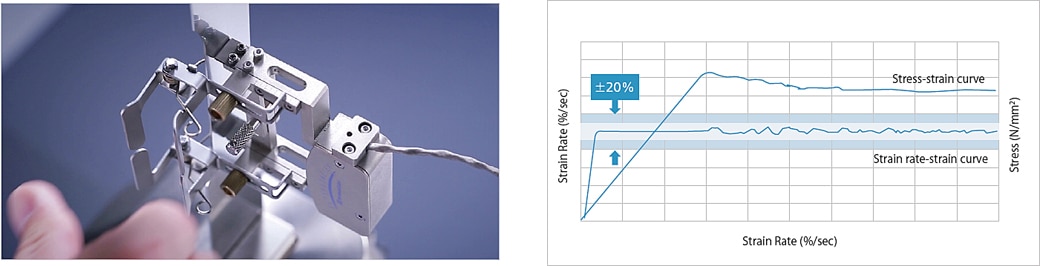
Strain rate control, in which the rate of deformation measured by an extensometer is controlled to be constant, requires highly accurate control to follow rapid changes in material behavior.
Metal Tensile Test Standard: ISO 6892:2016(JIS Z 2241:2011) specifies that the allowable range of increase in strain to the yield point is ± 20% or less. The strain rate control specified in ISO 6892:2016(JIS Z 2241:2011) is possible*1 to achieve with the AGX-V for many materials.
Practical Simulation Testing
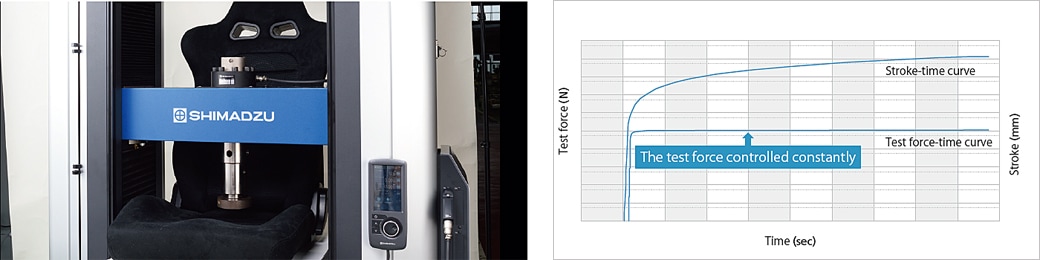
To maintain engine mounts and other rubber materials at a constant test force, it is necessary to gradually change the retention position to suit the characteristics of the test sample. To maintain the test force at a constant value requires high control stability, with high control responsiveness and no vibrations generated due to excessive response.
Free Running Compression Testing
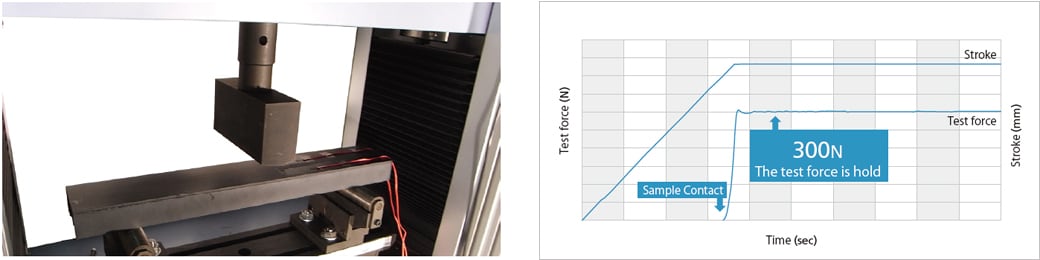
Stable control is achieved even in free running compression tests. In these tests, the compression indenter or bending punch is allowed to run free until it contacts the sample, at which point the load is increased up to a set test force. The overshoot of the target value is reduced, even with highly rigid materials, resulting in high-accuracy test force retention.