


Analysis of Indoor Air Quality
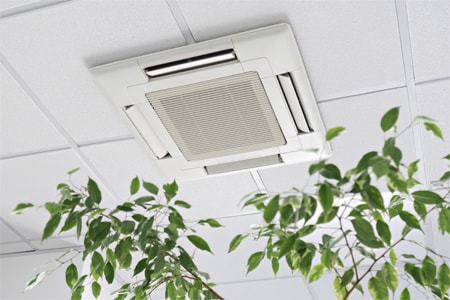
Indoor air quality (also called "indoor environmental quality") describes how inside air can affect a person's health, comfort, and ability to work. It can include temperature, humidity, lack of outside air (poor ventilation), mold from water damage, or exposure to other chemicals. Currently, OSHA has no indoor air quality (IAQ) standards, but it does provide guidelines about the most common IAQ workplace complaints. The National Institute for Occupational Safety and Health (NIOSH) is the federal institute responsible for conducting research and making recommendations for the prevention of work-related injury and illness. NIOSH is part of the Centers for Disease Control and Prevention (CDC), Common indoor air pollutants include, but are not limited to, volatile organic compounds, particulate matter, trace metals, and carbon monoxide. Sampling can include collection of air in containers or bags, pulling a known volume through adsorption tubes, passive capture on surfaces, and handheld monitors or kits. For greatest accuracy laboratory methods using sophisticated instrumentations is recommended. NIOSH Methods may be found in the NIOSH Manual of Analytical Methods, or at ASTM Committee D22 Air Quality Volume 11.07.
Gas Chromatograph-Mass Spectrometry
GC/MS analysis is a highly sensitive technique used to separate, identify, and quantify individual components collected from air samples. It is particularly effective for detecting volatile and semi-volatile compounds at trace levels. Both liquid injections for sample introduction from molecular sieves, Tenax or polyurethane foam extracts, direct injection from canisters and thermal desorption may be used ensuring precise identification and quantification, even in low-concentration samples.
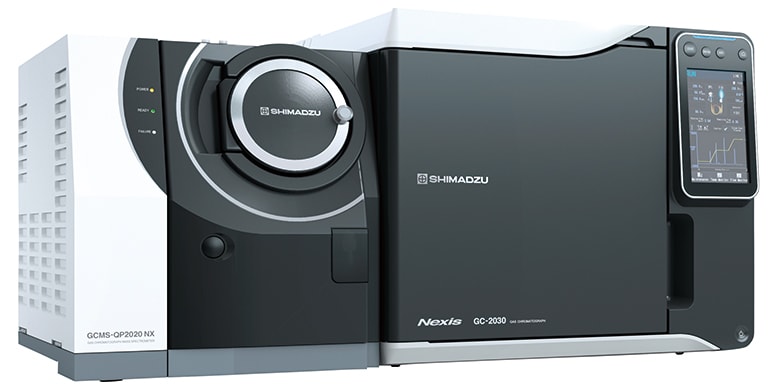
The Shimadzu GCMS-QP2020 NX Single Quadrupole GC-MS is capable of enhancing sensitivity with Chemical Ionization and enables alternative carrier gases like hydrogen and even nitrogen.
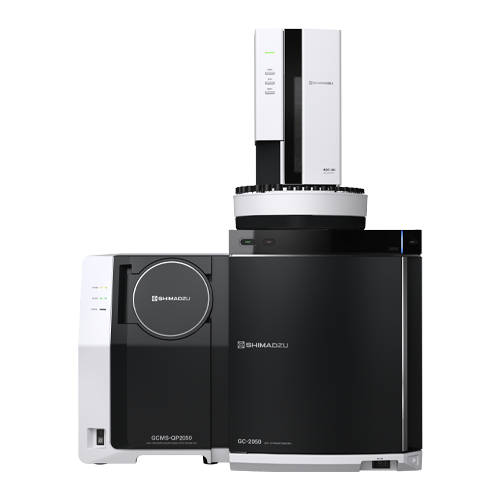
The Shimadzu GCMS-QP2050 Single Quadrupole GC-MS is our latest, fastest scanning GC-MS with our highest S/N when using Electron Ionization. A new ion source maximizes uptime while minimizing maintenance to three simple steps in just one minute.
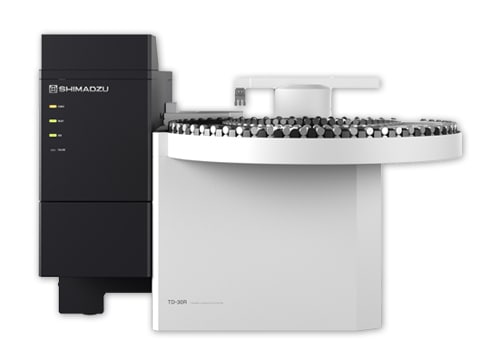
Use the TD-30 thermal desorption accessory for reliable, automated, analysis of indoor and outdoor air samples collected on thermal desorption tubes. The TD-30R has a maximum capacity of 120 samples, which allows processing a large number of samples via consecutive analyses overnight and on weekends. Use the TD-30 with a Shimadzu QP-2020NX to measure PFAS or other VOCs and SVOCs in indoor air .
Ion Chromatography
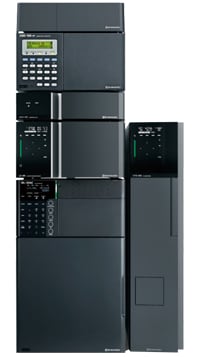
Ion Chromatography may be used to analyze eluents from sorbent tubes for anions such as fluoride, chloride, nitrate, bromide, phosphate or sulfate. The Prominence IC leverages the precision of Shimadzu’s HPLC instruments and ensures clean separations, highly repeatable injections and reliable analyses. Running ion chromatography standard test methods on the Prominence IC provides excellent resolution because there is no interference of the water dip on fluoride, and you can extend runs to maximize resolution and use higher injection volumes for trace analysis.
Inductively Coupled Plasma Mass Spectrometry
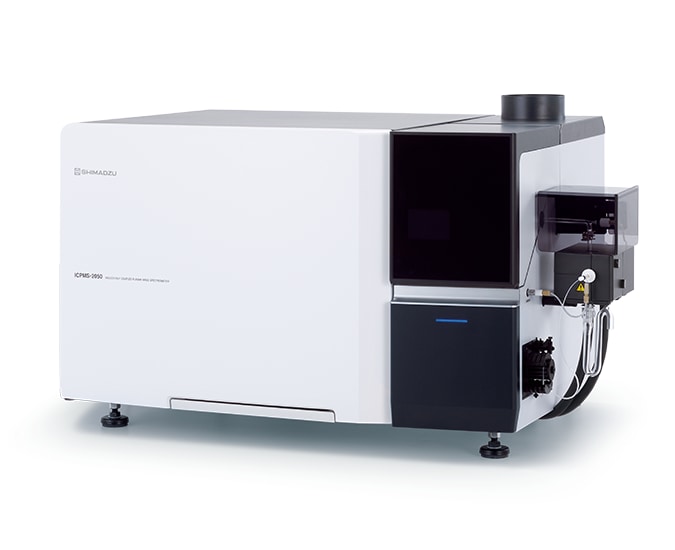
Inductively Coupled Plasma – Mass Spectrometry (ICP-MS) is a powerful tool used for the analysis of trace, minor, and major metals after acid digestion of particulates collected on glass fiber filters. It is particularly useful for laboratories that need to run a lot of metals in a lot of samples, with greater speed than traditional AA methods. The Shimadzu ICPMS-2040 and ICPMS-2050 series includes interelement correction (IEC), collision cell technology (CCT), reaction cell technology (RCT), and half-mass correction interference removal technology (IRT), ensuring accurate results, even in samples digestions containing hydrochloric acid. An aerosol dilution system enables aspiration of samples containing very high dissolved solids directly into the plasma. Other features include an advanced mini-torch design that keeps argon consumption low yet nearly doubles sensitivity and reduces injector clogging.
Featured Applications
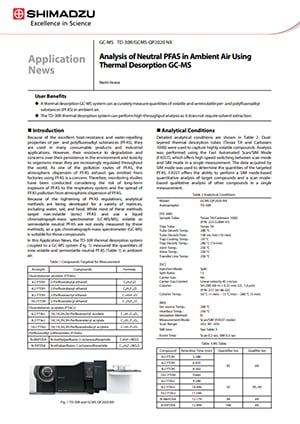
Analysis of Neutral PFAS in Ambient Air Using Thermal Desorption GC-MS
Because of the excellent heat-resistance and water-repelling properties of per- and polyfluoroalkyl substances (PFAS), they are used in many consumable products and industrial applications. However, their resistance to degradation and concerns over their persistence in the environment and toxicity to organisms mean they are increasingly regulated throughout the world. As one of the pollution routes of PFAS, the atmospheric dispersion of PFAS exhaust gas emitted from factories using PFAS is a concern. Therefore, monitoring studies have been conducted considering the risk of long-term exposure of PFAS to the respiratory system and the spread of PFAS pollution from atmospheric dispersion of PFAS. Because of the tightening of PFAS regulations, analytical methods are being developed for a variety of matrices, including water, soil, and food. While most of these methods target non-volatile (ionic) PFAS and use a liquid chromatograph-mass spectrometer (LC-MS/MS), volatile or semivolatile neutral PFAS are not easily measured by these methods, so a gas chromatograph-mass spectrometer (GC-MS) is suitable for those compounds. In this Application News, the TD-30R thermal desorption system coupled to a GC-MS system (Fig. 1) measured the quantities of nine volatile and semivolatile neutral PFAS in ambient air.
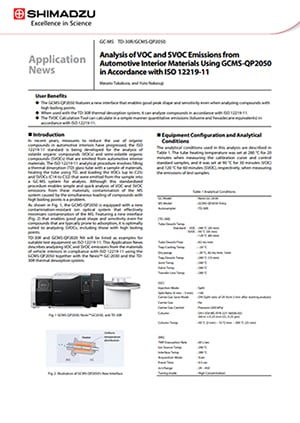
Analysis of VOC and SVOC Emissions from Automotive Interior Materials Using GCMS-QP2050 in Accordance with ISO 12219-11
In recent years, measures to reduce the use of organic compounds in automotive interiors have progressed, the ISO 12219-11 standard is being developed for the analysis of volatile organic compounds (VOCs) and semi-volatile organic compounds (SVOCs) that are emitted from automotive interior materials. The ISO 12219-11 analytical procedure involves filling a thermal desorption (TD) glass tube with a sample of materials, heating the tube using TD, and loading the VOCs (up to C25) and SVOCs (C14 to C32) that were emitted from the sample into a GC-MS system for analysis. Although this standardized procedure enables simple and quick analysis of VOC and SVOC emissions from these materials, contamination of the MS system caused by the simultaneous loading of compounds with high boiling points is a problem. As shown in Fig. 1, the GCMS-QP2050 is equipped with a new contamination-resistant ion optical system that effectively minimizes contamination of the MS. Featuring a new interface (Fig. 2) that enables good peak shape and sensitivity even for compounds that are typically prone to adsorption, it is optimally suited to analyzing SVOCs, including those with high boiling points. TD-30R and GCMS-QP2020 NX will be listed as examples for suitable test equipment on ISO 12219-11. This Application News describes analyzing VOC and SVOC emissions from the materials of vehicle interiors in compliance with ISO 12219-11 using the GCMS-QP2050 together with the NexisTM GC-2030 and the TD30R thermal desorption system.