


Analysis of Outdoor Air Quality

The EPA requires that states regulate hazardous air pollutants (HAP) from large industrial facilities. Regulations are set by as emission limits based on various industry sector groups, including but not limited to chemical production, electric utilities, oil and gas, and petroleum refineries. CWA regulations and methods can be found at 40 CFR Part 50-99.
40 CFR Part 61 lists national emission standards for hazardous air pollutants including, but not limited to, volatile organic compounds, trace metals, and radio nuclides.
The Air Emission Measurement Center (EMC) provides a comprehensive list of all approved and alternative test methods for stationary and other industrial sources.
The Ambient Monitoring Technology Information Center (AMTIC) provides a Compendium of Methods for the Determination of Toxic Organic Compounds in Ambient Air. The Compendium contains a set of 17 peer reviewed, standardized methods for the determination of volatile, semi-volatile, and selected toxic organic pollutants in the air.
SW-846 Methods 0010-0100 cover sampling methods for emissions from stationary sources such as hazardous and municipal waste incinerators. Targeted parameters for these methods include hazardous organic compounds (e.g., volatiles, semivolatiles, dioxins and dibenzofurans), metals, hydrogen chloride, chlorine, and hexavalent chromium. SW-846 also includes three methods which were referred to from the Clean Air Act program.
Fenceline monitoring uses EPA Methods 325A and 325B to measure the ambient air concentration of specific chemicals at the property line or perimeter of a manufacturing site (e.g., petroleum refinery, chemical plant). Samples are collected in sorbent tubes and are analyzed for trace levels of benzene, or other volatile organic compounds.
Gas Chromatograph-Mass Spectrometry
GC/MS analysis is a highly sensitive technique used to separate, identify, and quantify individual components collected from air samples. It is particularly effective for detecting volatile and semi-volatile compounds at trace levels. Both liquid injections for sample introduction from molecular sieves, Tenax or polyurethane foam extracts, direct injection from canisters and thermal desorption may be used ensuring precise identification and quantification, even in low-concentration samples.
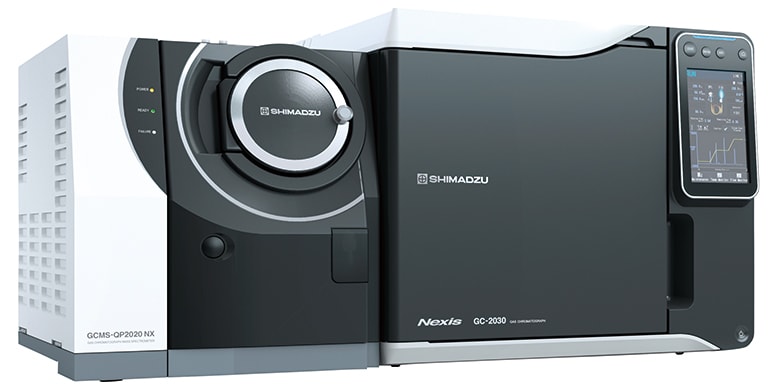
The Shimadzu GCMS-QP2020 NX Single Quadrupole GC-MS is capable of enhancing sensitivity with Chemical Ionization and enables alternative carrier gases like hydrogen and even nitrogen.
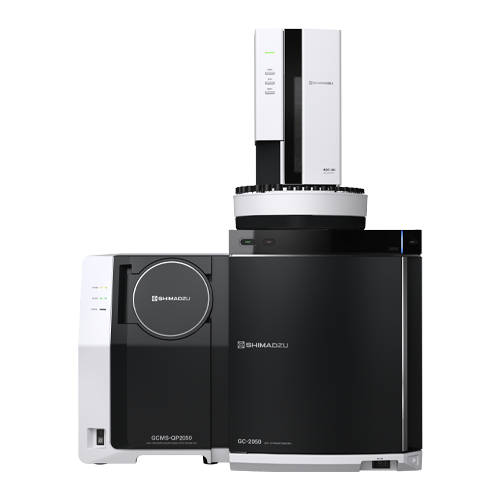
The Shimadzu GCMS-QP2050 Single Quadrupole GC-MS is our latest, fastest scanning GC-MS with our highest S/N when using Electron Ionization. A new ion source maximizes uptime while minimizing maintenance to three simple steps in just one minute.
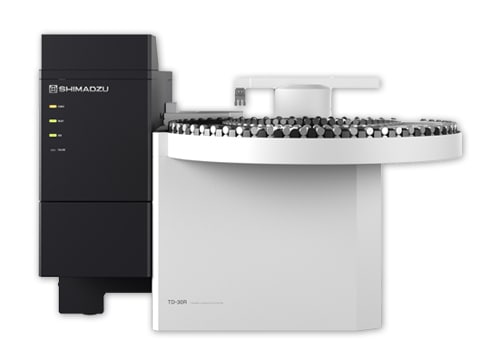
Use the TD-30 thermal desorption accessory for reliable, automated, analysis of indoor and outdoor air samples collected on thermal desorption tubes. The TD-30R has a maximum capacity of 120 samples, which allows processing a large number of samples via consecutive analyses overnight and on weekends. The TD-30 combined with either Shimadzu GCMS instrument is perfect for fenceline monitoring applications.
Ion Chromatography
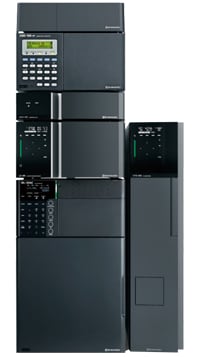
Ion Chromatography may be used to analyze impinger solutions for anions such as fluoride, chloride, nitrate, or sulfate. Prominence IC leverages the precision of Shimadzu’s HPLC instruments and ensures clean separations, highly repeatable injections and reliable analyses. Running ion chromatography standard test methods on the Prominence IC provides excellent resolution because there is no interference of the water dip on the early-eluting peaks, and you can extend runs to maximize resolution and injection volume for trace analysis
ICP-AES / ICP-MS
ICP-AES or ICP-MS may be used to analyze trace metals in impinger solutions or extracted from glass fiber filters.
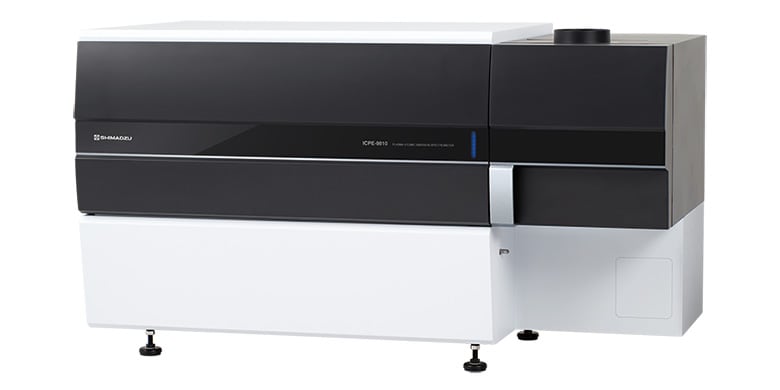
Multitype ICP Emission Spectrometer
Inductively Coupled Plasma – Atomic Emission Spectrometer (ICP-AES) is an ideal technique to do major and minor metals in impinger solutions or digested from glass fiber filters. It is particularly useful in laboratories that must run a lot of metals per sample. The instrument enables both radial and an axial ICP view for lower concentrations of some metals. A vertical torch minimizes contamination, shortening analysis times and lengthening intervals between maintenance.
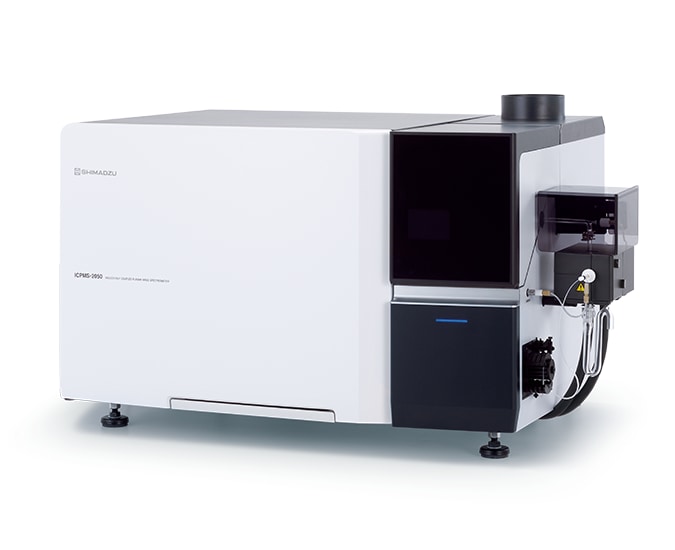
Inductively Coupled Plasma Mass Spectrometer
Inductively Coupled Plasma – Mass Spectrometry (ICP-MS) is a powerful tool used for the analysis of trace, minor, and major metals. It is particularly useful for laboratories that need to run a lot of metals in a lot of samples. The Shimadzu ICPMS-2040 and ICPMS-2050 series includes interelement correction (IEC), collision cell technology (CCT), reaction cell technology (RCT), and half-mass correction interference removal technology (IRT), ensuring accurate results, even in the most demanding samples. An aerosol dilution system enables aspiration of samples containing very high dissolved solids directly into the plasma. Other features include an advanced mini-torch design that keeps argon consumption low yet nearly doubles sensitivity and reduces injector clogging.