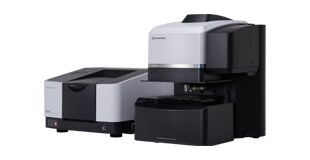


Analysis of Dyes and Pigments in Cosmetics and Personal Care Products

Choosing a color palette for your product can be daunting, as the formulation needs to meet texture expectations, the color needs to remain stable over time, and transfer – or not – to your customer depending on the product design. Our IR microscopes can analyze pigment degradation and permeation, while our benchtop MALDI systems can help you identify adulterated pigment ingredients before they’re sent to production.
Featured Applications
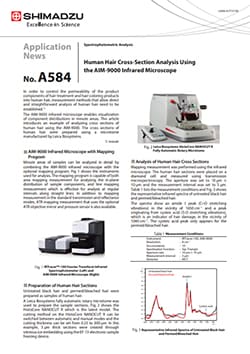
Human Hair Cross-Section Analysis Using the AIM-9000 Infrared Microscope
This study examines key molecular components of human hair, focusing on amide I (protein structure indicator) and cysteic acid, a critical marker of chemical damage formed during bleaching and perming processes. Understanding how treatments penetrate and alter hair at the molecular level supports the design of more effective, damage-conscious formulations. The method employs FTIR spectroscopy with spatial mapping to visualize chemical distributions across hair cross-sections. Thin sections (~3 μm) are prepared and followed by transmission-based infrared mapping at 10 μm × 10 μm spatial resolution and 5 μm intervals, with spectral acquisition at 8 cm⁻¹ resolution. Analysis is conducted using the Shimadzu AIM 9000 Infrared Microscope paired with the IRTracer™ 100 FTIR spectrophotometer, enabling both area and line mapping as well as multivariate analysis. The ability to visualize chemical composition and damage distribution at the micro-scale provides powerful, direct evidence of treatment effects within hair fibers and enabling more precise formulation optimization.
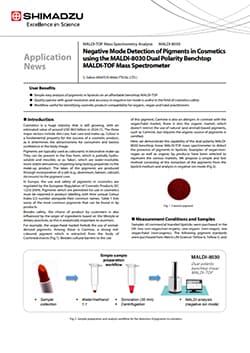
Negative Mode Detection of Pigments in Cosmetics using the MALDI-8030 Dual Polarity Benchtop MALDI-TOF Mass Spectrometer
Demonstrating high-confidence pigment identification in cosmetic formulations with cutting-edge MALDI-TOF mass spectrometry, this study investigates a range of widely used colorants in lip products, including Carmine (CI 75470), Red 7, Red 22, Red 28, Yellow 5 Lake, and Yellow 6 Lake, highlighting both synthetic and naturally derived pigments critical to product performance and labeling compliance this project demonstrates verification of ingredient claims across vegan, halal, organic, and conventional product categories while ensuring product safety and transparency. The methodology utilizes matrix-assisted laser desorption/ionization time-of-flight (MALDI-TOF) mass spectrometry with a streamlined workflow involving pigment extraction, sonication, and negative ion mode analysis. Measurements are performed using the Shimadzu MALDI 8030 Dual Polarity Benchtop MALDI TOF Mass Spectrometer, with confirmatory analysis via MALDI MS/MS where needed. The approach leverages isotopic pattern recognition and accurate mass detection for confident pigment identification.
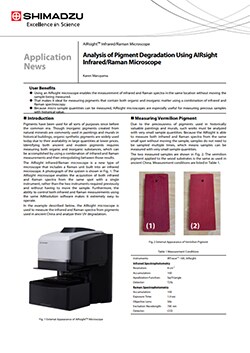
Analysis of Pigment Degradation Using AIRsight Infrared/Raman Microscope
As an analysis of pigment stability with a powerful, dual-technique microscopy approach, this study investigates historical and modern pigment components, including mercury sulfide (HgS, cinnabar), lead oxide (Pb₃O₄), barium sulfate (BaSO₄), and calcium carbonate (CaCO₃), along with their structural changes under UV exposure. Combined infrared (FTIR) spectroscopy with a Raman microscope analyzes both organic and inorganic pigment constituents at the same microscopic location. Measurements are performed using the Shimadzu AIRsight™ Infrared/Raman Microscope integrated with the IRTracer™ 100 FTIR, enabling high-resolution spectral acquisition without repositioning the sample. Analytical conditions include 8 cm⁻¹ resolution for IR, Raman excitation at 785 nm. Simultaneous, co-localized chemical characterization of complex pigment systems from extremely small samples, enabled precise evaluation of degradation mechanisms and supporting the development of more stable, high-performance cosmetic formulations.
Negative Mode Detection of Sulfonated Azo Colourants in Sweets/Candies using the MALDI8030 Dual Polarity Benchtop MALDI-TOF Mass Spectrometer
Showing identification of regulated colorants with a powerful MALDI TOF mass spectrometry workflow designed for complex matrices, this study focuses on widely used sulfonated azo dyes, including Sunset Yellow FCF (E110), Tartrazine (E102), Allura Red AC (E129), and Brilliant Blue FCF (E133) These synthetic pigments are valued for their stability, solubility, and vibrant color performance but are subject to regulatory oversight globally, so accurate characterization and verification of colorant composition is critical for export products. Ion-pair extraction was combined with matrix-assisted laser desorption/ionization time-of-flight (MALDI-TOF) mass spectrometry to selectively isolate and detect target dyes. Analysis is performed in negative ion mode using the Shimadzu MALDI 8030 Dual Polarity Benchtop MALDI TOF Mass Spectrometer, enabling direct detection of intact dye species with excellent mass accuracy and isotopic resolution. Rapid, high-resolution screening of complex samples with minimal preparation, allowed efficient identification of regulated pigments to support quality control, safety assurance, and formulation screening in modern product development.