

Analysis of Active Ingredients in Sunscreen
Sunscreen and UV filters are popular among consumers needing to reduce their sun exposure while being outdoors, but finding formulations that are fast drying, avoiding white cast, and are resistant to water, sand and salt can be difficult. Globally, sunscreens are regulated by different bodies, so formulating for export comes with testing needs. Our UV-Vis analyzers and HPLC systems can help you monitor labeling and support your product development.
Featured Applications
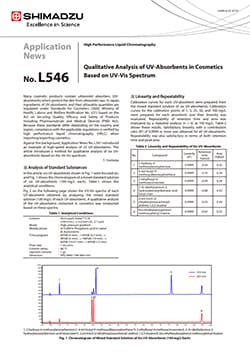
Qualitative Analysis of UV-Absorbents in Cosmetics Based on UV-Vis Spectrum
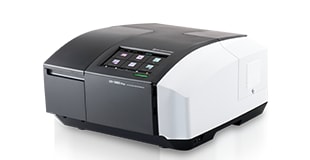
Sunscreen and cosmetic formulation analysis with a streamlined UV Vis spectroscopic approach designed for rapid qualitative screening. This study examines common UV absorbing compounds used in cosmetics, including benzophenone derivatives, cinnamate-based absorbers, and other organic UV filters that play a critical role in protecting skin from ultraviolet radiation. Accurate identification of UV filters ensures product safety, regulatory compliance, and consistent performance in sun protection formulations. The methodology utilizes UV Visible spectrophotometry to identify UV absorbents based on their characteristic absorption spectra. Measurements are conducted using a Shimadzu UV 1900 series spectrophotometer, operating across relevant wavelength ranges to capture distinct spectral fingerprints of each compound. The fast, simple, and non-destructive screening of UV filters, enabling efficient quality control and formulation verification while reducing analysis time and operational complexity.
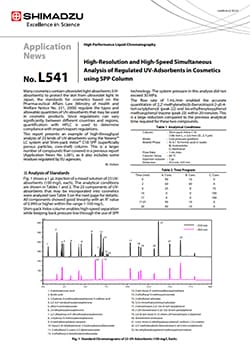
High-Resolution and High-Speed Simultaneous Analysis of Regulated UV-Adsorbents in Cosmetics using SPP Column
High-speed, high-resolution insight into cosmetic formulation safety is possible with this advanced UHPLC method for preservative analysis. This study investigates a broad range of 24 cosmetic preservatives, including parabens (methyl, ethyl, propyl, butyl), 2 phenoxyethanol, benzoic acid, sorbic acid, triclosan, and isothiazolinone derivatives which are critical compounds used to maintain product stability and microbial safety. Preservative levels must be tightly controlled to ensure product safety, shelf life, and adherence to global standards governing ingredient concentrations. The methodology utilizes ultra-high performance liquid chromatography (UHPLC) for simultaneous multi-component separation and detection. Analysis is performed using the Shimadzu Nexera™ UHPLC paired with a Shim pack™ Velox C18 SPP (core shell) column and SPD M40 photodiode array detector, achieving full separation of all target compounds in approximately 9 minutes under controlled temperature and pressure conditions. This platform delivers exceptional resolution with rapid analysis time, enabled by core shell particle technology that produces sharper peaks and improved efficiency for high-throughput, accurate quantification in complex cosmetic matrices.