

Identifying Contaminants in Cosmetics and Personal Care Products

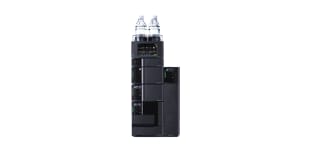
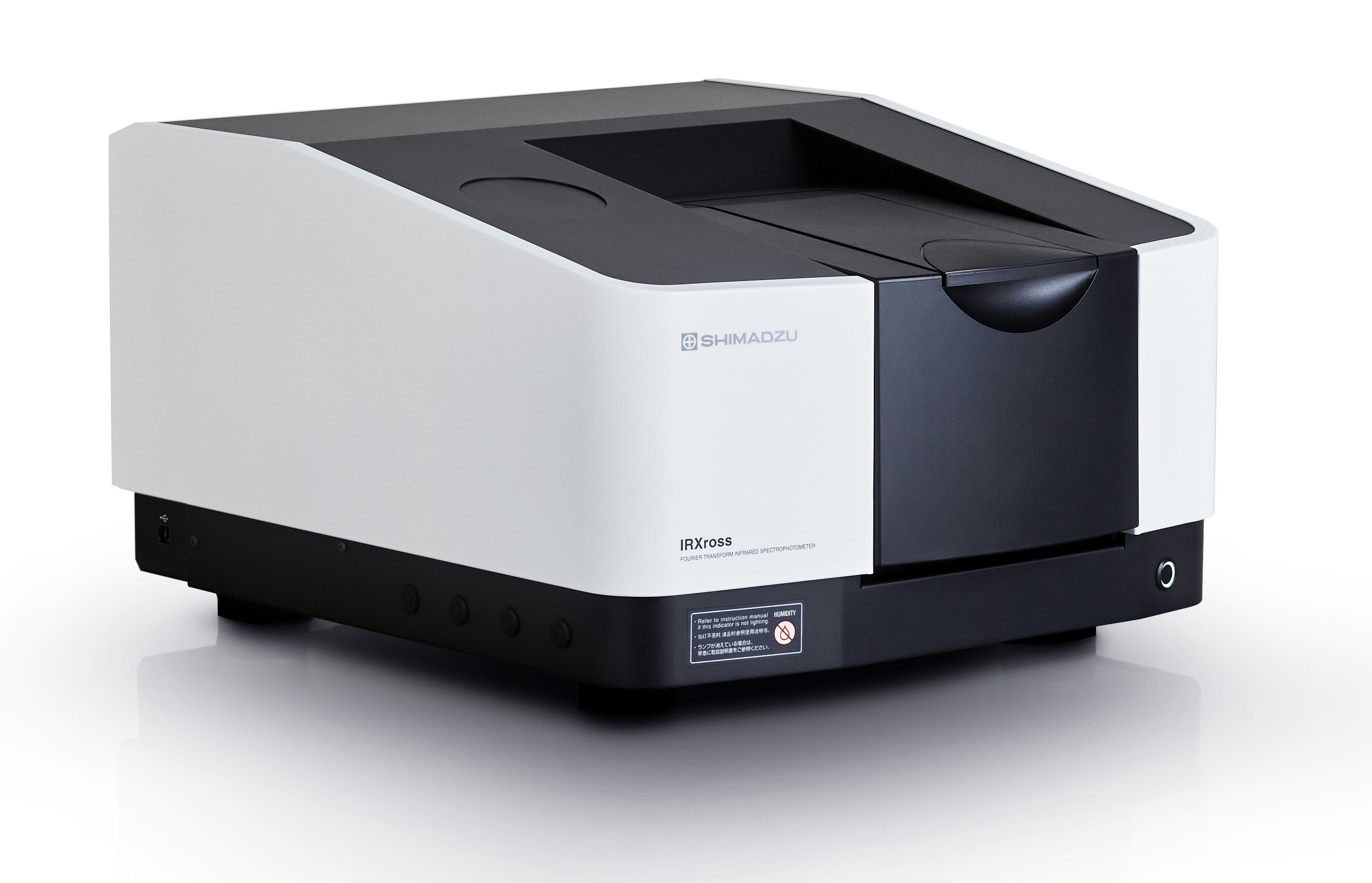
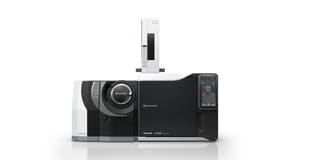
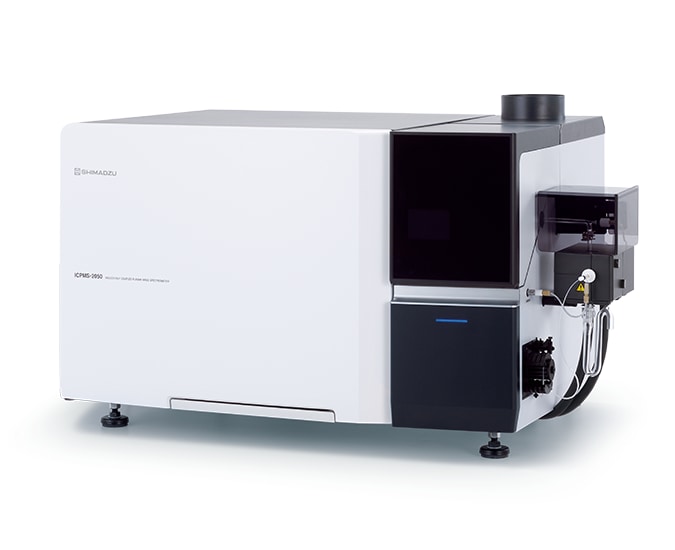
Contaminants can arise from a variety of sources, between ingredient supply, processing, or mishandled packaging. Screening for these often requires sensitive instruments that can detect low concentrations. Our extensive range of analytical testing instruments, including HPLC, LCMS, FTIR, GCMS, and ICPMS, can help you screen for a variety of contaminants.
Featured Applications
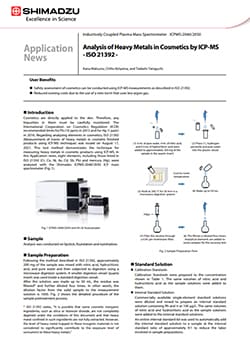
Analysis of Heavy Metals in Cosmetics by ICP-MS -ISO 21392 -
Adherence to ISO 21392 and global safety guidelines requires sensitive, accurate quantification of trace metals to ensure product quality and consumer protection. This study investigates critical heavy metal contaminants, including lead (Pb), cadmium (Cd), mercury (Hg), arsenic (As), and other trace elements, which may be present in raw materials or finished products and must be tightly controlled due to potential health risks. The methodology employs inductively coupled plasma mass spectrometry (ICP MS) using the Shimadzu ICPMS 2030 system, operating under optimized plasma conditions and multi-element detection modes to achieve precise quantification across a broad mass range. Ultra-trace detection with excellent accuracy and multi-element capability enables rapid, high-throughput screening of heavy metals and supports robust quality control, regulatory adherence, and safe cosmetic product development.
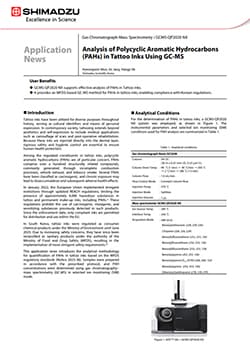
Analysis of Polycyclic Aromatic Hydrocarbons (PAHs) in Tattoo Inks Using GC-MS
Tattoo inks are introduced into the dermal layer, requiring strict monitoring of hazardous substances to meet evolving global regulations and protect human health. Ensure the highest level of safety in tattoo and permanent makeup formulations with a robust GC MS method for trace contaminant analysis. This study focuses on polycyclic aromatic hydrocarbons (PAHs) which are associated with carcinogenic and bioaccumulative risks. Employing gas chromatography–mass spectrometry (GC MS) with selected ion monitoring (SIM) this method delivers highly selective detection. Analysis is performed using the Shimadzu GCMS QP2020 NX mass spectrometer coupled with the Nexis™ GC 2030 and AOC™ 30i autosampler. Sample preparation includes extraction, purification, and internal standard calibration to ensure analytical accuracy. Exceptional sensitivity and selectivity for trace-level contaminants provides accurate quantification with excellent linearity, precision, and regulatory compliance, empowering reliable quality control and safer cosmetic product development.
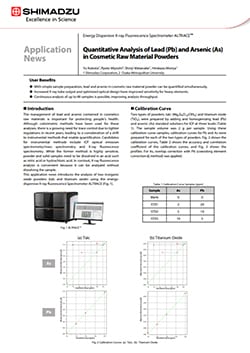
Quantitative Analysis of Lead (Pb) and Arsenic (As) in Cosmetic Raw Material Powders
Ensure safer cosmetic formulations with a fast, non-destructive approach to trace heavy metal analysis in raw materials. Contaminants like lead (Pb) and arsenic (As) contaminate common cosmetic powders such as talc and titanium dioxide, materials widely used in color and base formulations. Controlling these elements is essential for cosmetics safety and regulatory compliance, as increasingly strict global guidelines demand accurate monitoring of toxic metals to protect consumer health and maintain product quality. The methodology employs energy-dispersive X-ray fluorescence (EDXRF) for direct quantitative analysis without sample digestion. Measurements are conducted using the Shimadzu ALTRACE energy-dispersive X-ray fluorescence spectrometer, operating with optimized tube voltage, detector configuration, and integration times to simultaneously detect Pb and As in solid powders. A calibration curve-based method enables accurate quantification across relevant concentration ranges, while simple sample preparation streamlines the workflow. The rapid, simultaneous multi-element analysis of this method with minimal sample preparation, delivered high throughput, improved sensitivity, and reliable quantification and is an ideal setup for efficient quality control and safer cosmetic product development.
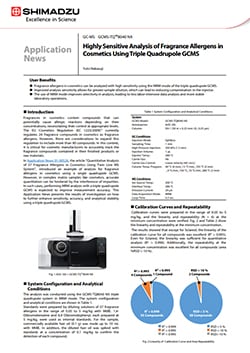
Highly Sensitive Analysis of Fragrance Allergens in Cosmetics Using Triple Quadrupole GCMS
This GC-MS workflow is designed for complex cosmetic matrices for the ultra-sensitive detection of fragrance allergens. A range of fragrance allergen compounds were targeted, including key constituents such as linalool, limonene, citronellol, coumarin, eugenol, and other regulated aroma chemicals, which are widely used in perfumed formulations but associated with skin sensitization risk. This analytical capability supports cosmetics safety, labeling accuracy, and regulatory compliance, as global regulations increasingly require precise quantification of allergenic fragrance components to ensure consumer protection. The methodology employs gas chromatography coupled with triple quadrupole mass spectrometry (GC-MS/MS) for highly selective and sensitive analysis. Measurements are performed using a Shimadzu GCMS-TQ™ system, operating in multiple reaction monitoring (MRM) mode to enhance specificity and reduce matrix interference. Exceptional sensitivity and selectivity are achieved through tandem MS detection, enabling accurate trace quantification of multiple allergens in a single run.
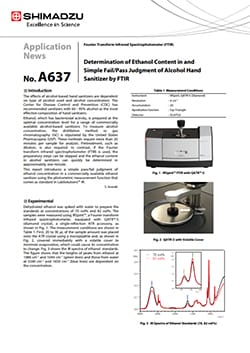
Determination of Ethanol Content in and Simple Fail/Pass Judgment of Alcohol Hand Sanitizer by FTIR
A rapid FTIR approach designed for precision and simplicity for quality control of alcohol-based formulations. This study focuses on ethanol and water, the primary components of hand sanitizers, evaluating ethanol concentration through characteristic infrared absorption peaks such as C–O stretching vibrations (~1044–1086 cm⁻¹) and water bands (~3340 and 1650 cm⁻¹). Such analysis is critical for cosmetics and personal care manufacturing, where maintaining effective alcohol concentrations ensures product performance, safety, and compliance with recommended standards for antimicrobial efficacy. The methodology employs Fourier transform infrared (FTIR) spectroscopy with ATR sampling, enabling direct measurement without dilution or pretreatment. Analysis is performed using the Shimadzu IRSpirit™ FTIR spectrophotometer equipped with a QATR™ S diamond ATR accessory, operating at 4 cm⁻¹ resolution with multiple accumulations for reliable spectral acquisition. The integrated LabSolutions™ IR photometric function enables automated calculation of ethanol concentration and real-time pass/fail judgment based on defined spectral criteria in a fast, one-minute analysis with minimal sample preparation.
Multiresidue Pesticides Analysis in Norbixin Color Additive using LCMS-8050 and GCMS-TQ8040 NX
Natural pigments can carry trace pesticide contaminants from agricultural processes, requiring precise monitoring to ensure product purity, regulatory compliance, and consumer protection. This study presents a powerful multi-residue screening for natural color additives with an advanced tandem mass spectrometry workflow. Norbixin, a carotenoid pigment derived from annatto and widely used in cosmetic color formulations was screened for 72 pesticide residues, spanning diverse chemical classes such as organophosphates, carbamates, neonicotinoids, and pyrethroids. The methodology integrates a modified QuEChERS extraction and clean up procedure with complementary LC-MS/MS and GC-MS/MS analysis for comprehensive coverage of both polar and nonpolar compounds. Measurements are performed using the Shimadzu LCMS 8050 triple quadrupole system coupled with the Nexera™ X2 platform, alongside the GCMS TQ™8040 NX, enabling precise quantification under optimized ionization, temperature, and detection conditions. This combination of mass spectrometry methods delivers high-sensitivity, wide-spectrum detection with excellent reproducibility, enabling trace-level quantification even in complex matrices.
A Direct Method for the Determination of 13 Nitrosamines in Water by LCMS-8045 System
Nitrosamines can form as unintended byproducts during formulation or storage, making reliable detection essential for ensuring product safety, regulatory compliance, and consumer trust. Nitrosamine contaminant monitoring with a highly sensitive LC MS/MS approach is an efficient solution to identifying these byproducts. This study focuses on 13 nitrosamine compounds, including key species such as NDMA, NDEA, NDPA, NDBA, and related N nitrosamines, which are of growing concern due to their potential carcinogenicity even at ultra low concentrations. The methodology employs a direct injection LC-MS/MS technique, minimizing sample preparation while maintaining high analytical performance. Measurements are carried out using the Shimadzu LCMS-8045 triple quadrupole mass spectrometer, operated under optimized electrospray ionization and multiple reaction monitoring (MRM) conditions. This method delivers exceptional sensitivity with streamlined workflow, enabling ultra-trace detection without extensive cleanup and is ideal for efficient, high-confidence monitoring of nitrosamine contaminants in complex matrices.
Multiresidue pesticides analysis in Curcumin color additive powder using GCMS-TQ8040 NX and LCMS-8050
Ensuring the purity of such botanical color additives is essential for cosmetics manufacturing and consumer safety, as agricultural sources can introduce trace pesticide contamination that must be tightly controlled to meet global quality standards. This study targets 72 pesticide residues spanning classes such as organophosphates, carbamates, pyrethroids, and neonicotinoids, evaluated within curcumin, a widely used natural pigment derived from turmeric and employed in cosmetic formulations. The methodology integrates a modified QuEChERS extraction and clean up procedure to efficiently isolate analytes from the complex curcumin matrix, followed by triple quadrupole LC-MS/MS and GC-MS/MS analysis. Measurements are performed using the Shimadzu LCMS-8050 triple quadrupole system coupled with a Nexera™ platform and the GCMS TQ™8040 NX, enabling effective detection of both polar and nonpolar pesticides under optimized ionization and temperature conditions. This dual-platform approach delivers broad compound coverage with exceptional sensitivity and reproducibility, enabling reliable trace-level quantification in challenging matrices and supporting robust quality assurance for cosmetic color ingredients.
Analysis of residual pesticides in Carrotoleoresin using GCMS-TQ8040 NX and LCMS-8045
Plant-derived ingredients can carry trace contaminants from agricultural practices, requiring precise monitoring to ensure product safety, purity, and compliance with global standards. Deliver exceptional confidence in natural colorant safety with an advanced multi-residue pesticide screening approach. This study investigates a broad panel of pesticide residues, including organophosphates, carbamates, pyrethroids, and neonicotinoids, present in complex botanical matrices such as curcumin or carrot-derived oleoresins, widely used as natural pigments in cosmetic formulations. The methodology combines a modified QuEChERS extraction and clean-up procedure with tandem mass spectrometry using both LC-MS/MS and GC-MS/MS to achieve comprehensive coverage of analytes. Analysis is performed using the Shimadzu LCMS-8050 triple quadrupole system coupled with a Nexera™ platform and the GCMS TQ™8040 NX, enabling detection of both polar and nonpolar compounds under optimized ionization and temperature conditions. High-sensitivity, wide-spectrum detection with excellent reproducibility are enabled by this dual-platform approach, providing reliable trace-level quantification in highly complex matrices and supporting robust quality control and advancing confidence in cosmetic ingredient safety.