

Air Pollution Monitoring and Analysis

Air pollution refers to contamination of indoor or outdoor air by harmful constituents. The Clean Air Act (CWA) established by the United States Congress requires the US EPA to establish ambient air pollution criteria. EPA has defined particulate matter, ozone, sulfur dioxide, nitrogen dioxide, carbon monoxide, and lead as “criteria pollutants”. States are required to ensure air quality meets these standards. The regulations generally apply to stack emissions (stationary sources. The Department of Labor Occupational Safety and Health Administration (OSHA) regulates the quality of indoor air inside schools, offices, and other workplaces for workers’ comfort and health. Usually, indoor air quality can be rectified using engineering controls, however, monitoring of chemical contaminants is often required to demonstrate compliance.
Measuring fluorotelomer alcohols by thermal desorption-gas chromatography-tandem mass spectrometry
Journal of Chromatography A Volume 1769, 22 February 2026, 466725
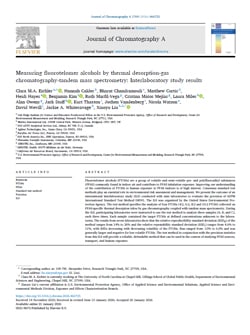
Fluorotelomer alcohols (FTOHs) are a group of volatile and semi-volatile per- and polyfluoroalkyl substances (PFAS) commonly found in indoor air and contribute to PFAS inhalation exposure. Improving our understanding of the contribution of FTOHs to human exposure to PFAS indoors is of high interest. Consensus standard test methods play an essential role in environmental risk assessment and management. We present the outcome of an international interlaboratory study (ILS) conducted with nine laboratories to evaluate the precision of ASTM International Standard Test Method D8591. The ILS was organized by the United States Environmental Protection Agency. The test method specifies the analysis of four FTOHs (4:2, 6:2, 8:2 and 10:2 FTOH) collected on PFAS-specific thermal desorption tubes by gas chromatography coupled with tandem mass spectrometry. During the ILS, participating laboratories were instructed to use the test method to analyze three samples (A, B, and C), each three times. Each sample contained the target FTOHs at defined concentrations unknown to the laboratories. The results from seven laboratories show that the relative reproducibility standard deviation (RSDR) of the method ranges from 14% to 26% and the relative repeatability standard deviation (RSDr) ranges from 4.6% to 11%, with RSDs decreasing with decreasing volatility of the FTOHs. Bias ranged from -13% to 6.0% and was generally larger and negative for less volatile FTOHs. The test method in conjunction with the precision statistics from this ILS will provide a reliable, defendable method that can be used in the context of studying PFAS sources, transport, and human exposure.