


Analysis of Inorganic Anions in Drinking Water

United States Primary Drinking Water regulations have set mandatory MCLs for inorganic anions in drinking water. These include fluoride, nitrate nitrogen, and nitrite nitrogen and are established to protect public health. The EPA has also set Secondary Contaminant levels (SMCL) that are monitored to assist water systems achieve aesthetic qualities of their water. Secondary contaminants include chloride and sulfate. These inorganic anions may be analyzed using Ion Chromatography following EPA Methods 300.0, or 300.1, Standard Methods 4110B, or ASTM D4327. Each of these methods use suppressed ion chromatography and are operationally identical. The conductivity suppressor-type IC enhances sensitivity by replacing the sodium ions in the eluent with hydrogen ion before detections of the target anions.
Related Products
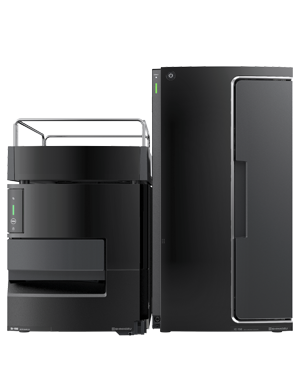
Ion Chromatograph Systems
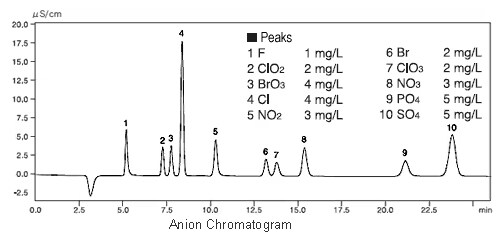
An ion chromatograph simultaneously analyzes primary and secondary pollutant inorganic anions without the need for special pretreatment. Chlorate in Tap Water and Bromate disinfection byproducts are also anions. These can be analyzed by IC. Using EPA Method 300.1, chlorate, chlorite, and bromate may also be analyzed by IC.
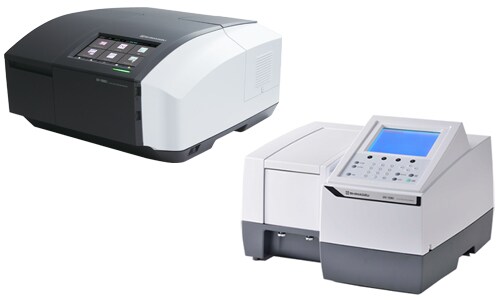
Featured Applications
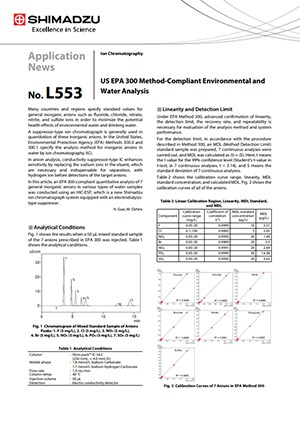
US EPA 300 Method-Compliant Environmental and Water Analysis
Many countries and regions specify standard values for general inorganic anions such as fluoride, chloride, nitrate, nitrite, and sulfate ions in order to minimize the potential health effects of environmental water and drinking water. A suppressor-type ion chromatograph is generally used in quantitation of these inorganic anions. In the United States, Environmental Protection Agency (EPA) Methods 300.0 and 300.1 specify the analysis method for inorganic anions in water by ion chromatography (IC). In anion analysis, conductivity suppressor-type IC enhances sensitivity by replacing the sodium ions in the eluent, which are necessary and indispensable for separation, with hydrogen ion before detections of the target anions. In this article, an EPA 300-compliant quantitative analysis of 7 general inorganic anions in various types of water samples was conducted using an HIC-ESP, which is a new Shimadzu ion chromatograph system equipped with an electrodialysistype suppressor.
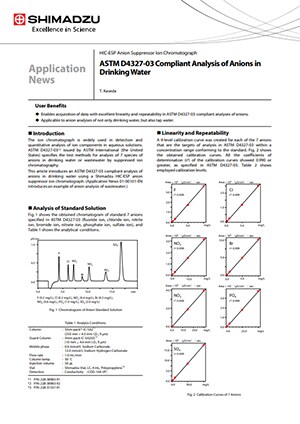
ASTM D4327-03 Compliant Analysis of Anions in Drinking Water
The ion chromatograph is widely used in detection and quantitative analysis of ion components in aqueous solutions. ASTM D4327-03 issued by ASTM International (the United States) specifies the test methods for analysis of 7 species of anions in drinking water or wastewater by suppressed ion chromatography. This article introduces an ASTM D4327-03 compliant analysis of anions in drinking water using a Shimadzu HIC-ESP anion suppressor ion chromatograph. (Application News 01-00101-EN introduces an example of anion analysis of wastewater.)