

Analysis of Antimicrobials in Cosmetics and Personal Care Products
Maintaining product safety over its shelf life and use window is a difficult task for any water based formulation. Additionally, creating personal care products used in wound care, piercings and tattoos necessitates a product that can gently remove bacteria but prevent damage to skin. Antimicrobial ingredients like copper and silver nanoparticles can be analyzed by our Electron Probe Microanalyzer. More traditional agents like benzalkonium chloride are easily analyzed by our HPLC systems that offer high speed analysis and remote start functionality to get you running your QA labs as efficiently as possible.
Featured Applications
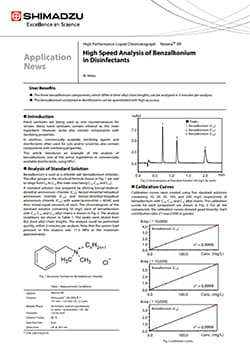
High Speed Analysis of Benzalkonium in Disinfectants
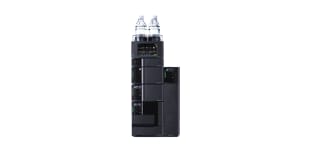
Fast, precise insight into disinfectant formulations with a high-speed HPLC method designed for rigorous quantitative analysis. This study focuses on benzalkonium chloride homologs, specifically C12, C14, and C16 alkyl chain variants, key active compounds widely used for antimicrobial performance. Benzalkonium compounds are incorporated into sanitizers and topical formulations, making accurate compositional understanding essential for product safety, efficacy, and regulatory compliance. The methodology employs high-performance liquid chromatography (HPLC) with rapid separation completed in approximately 3 minutes per run. Analytical conditions include a Shim-pack™ XR-ODSII column (75 mm × 3.0 mm, 2.2 µm), and UV detection at 265 nm. Analysis is performed using the Shimadzu Nexera™ XR system, delivering excellent linearity (r² ≥ 0.999) and high quantitation accuracy. This system’s exceptional speed and analytical reliability, enable high-throughput testing, reduced solvent consumption, and confident quantification of active ingredients in complex formulations.
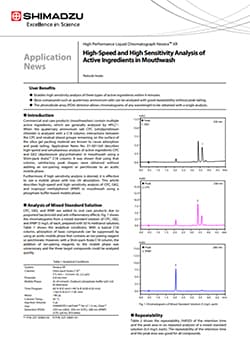
High-Speed and High Sensitivity Analysis of Active Ingredients in Mouthwash
This analytical capability enables precise quantification of ingredients that directly influence product efficacy, stability, and user safety to support high-sensitivity analysis of oral care formulations. The study focuses on three key active ingredients commonly used in mouthwash: cetylpyridinium chloride (CPC), dipotassium glycyrrhizinate (GK2), and isopropyl methylphenol (IPMP), compounds valued for their antimicrobial and anti-inflammatory performance. The method utilizes high-performance liquid chromatography (HPLC) with a phosphate buffer-based mobile phase to achieve both speed and sensitivity. Analytical conditions include a Shim-pack™ Arata C18 column (75 mm × 3.0 mm, 2.2 µm), with photodiode array (PDA) detection at multiple wavelengths (250–280 nm). Notably, all three compounds are separated in under 4 minutes without ion-pairing reagents. The study employs the Shimadzu Nexera™ XR system with SPD-M40 detector, delivering exceptional repeatability, reduced peak tailing for basic compounds, and high sensitivity, enabling fast, reliable trace-level quantification.
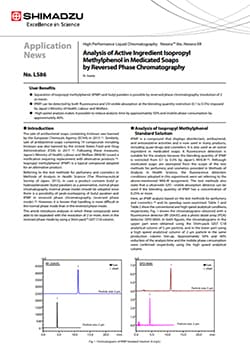
Analysis of Active Ingredient Isopropyl Methylphenol in Medicated Soaps by Reversed Phase Chromatography
Advanced analytical capabilities for medicated soap formulation analysis with a high-performance HPLC approach designed for precision, speed, and sensitivity. This study centers on isopropyl methylphenol (IPMP), a widely used antibacterial, alongside butyl paraben and other parabens, enabling clear separation and accurate quantification even in complex formulations. This work is a response to evolving regulatory pressures that have driven the shift toward alternative antimicrobial ingredients such as IPMP in soaps and topical products. The method utilizes reversed-phase high-performance liquid chromatography (HPLC) with optimized conditions to achieve robust separation. Key parameters include a Shim-pack™ GIST C18 column (150 × 3.0 mm, 2 µm), with detection via fluorescence (RF-20AXS) and PDA (SPD-M40 at 278 nm). High-speed columns reduce analysis time by ~50% while maintaining resolution. The analysis is performed using the Shimadzu Nexera™ XR and Nexera™ Lite systems, delivering superior sensitivity by RF (IPMP was detected with about 20 times higher sensitivity by the RF-20AXS compared to the SPD-M40), reproducibility, and efficiency, making them ideal for routine quality control and formulation optimization.
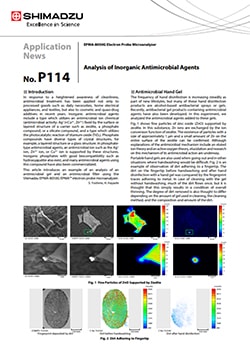
Analysis of Inorganic Antimicrobial Agents
Inorganic antimicrobial additives are increasingly incorporated into products such as hand gels, toothpaste, and functional coatings to enhance hygiene and durability. The work investigates key antimicrobial systems, including silver (Ag⁺), zinc (Zn²⁺), and copper (Cu²⁺) ions, along with zinc oxide (ZnO), titanium dioxide (TiO₂), hydroxyapatite (HAp), zeolites, and phosphate-based carriers as these materials are engineered for controlled antimicrobial activity. The study applies electron probe microanalysis (EPMA) to evaluate particle morphology, elemental distribution, and ion dispersion within complex matrices. Analytical conditions include high-resolution imaging and elemental mapping (e.g., ~15 kV accelerating voltage) to visualize nanoscale distributions of antimicrobial species across carrier materials. Analysis is performed using the Shimadzu EPMA 8050G Electron Probe Microanalyzer, delivering detailed compositional and spatial data. This instrument provides exceptional spatial resolution and quantitative elemental mapping, enabling researchers to precisely assess ion distribution, particle size, and structure as they are critical for optimizing antimicrobial performance and guiding next-generation material design.