

Identifying Allergens and Sensitivities in Cosmetics and Personal Care Products

With consumers demanding more natural products as well as sustainable and ethical formulations, brands are reformulating and adjusting their practices to meet those demands. Shimadzu can help you address these needs with a high-speed HPLC-based skin sensitization test without the need for human or animal subjects. Check out our GCMS analysis tests for screening known fragrance allergens as well, to help deliver clean unreactive products to your customers.
Featured Applications
Evaluating Technical Proficiency of ADRA Skin Sensitization Testing and High Speed Analysis
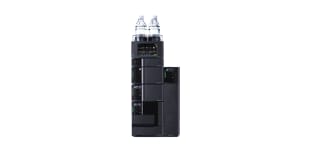
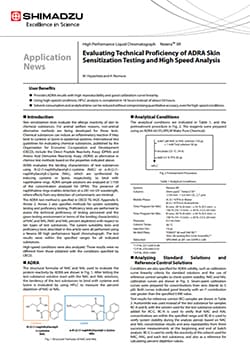
Understanding a compound’s potential to cause skin sensitization is essential for ensuring product safety while reducing reliance on animal testing. We present screening using a scientifically robust, high-throughput analytical workflow designed for modern cosmetic safety evaluation. This study demonstrates key peptide model compounds: N-(2-(1 naphthyl)acetyl)-L cysteine (NAC) and α N-(2-(1 naphthyl)acetyl)-L lysine (NAL) which mimic amino acid residues involved in protein binding, alongside representative test substances used to assess skin sensitization and reactivity. The methodology is based on the Amino Acid Derivative Reactivity Assay (ADRA), an OECD-recognized method. Test substances are incubated with NAC and NAL, and their reactivity is quantified by measuring peptide depletion using high-performance liquid chromatography (HPLC). Analysis is performed on the Shimadzu Nexera™ HPLC system equipped with a Shim-pack™ Velox C18 column and SPD M40 photodiode array detector, operating at controlled temperature, flow rate, and UV detection (281 nm) to ensure precise quantitation. High reproducibility and dramatically reduced analysis time, enabling reliable, rapid screening of sensitization potential which is critical for efficient, evidence-based cosmetic safety assessment.
Quantitative Analysis of 57 Fragrance Allergens in Cosmetics Using Twin Line MS System
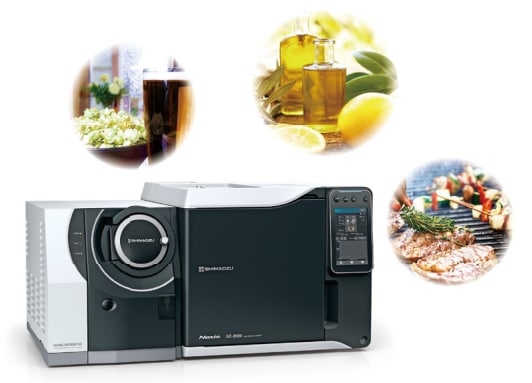
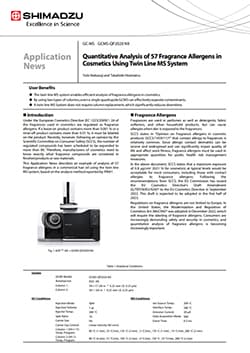
Accurate identification and quantification of allergens are required to meet evolving global labeling requirements and protect consumer health. A comprehensive, high-confidence profiling of fragrance allergens using an advanced GC-MS is demonstrated for complex cosmetic matrices. A broad panel of 57 regulated and emerging fragrance allergens was targeted, including key compounds such as linalool, limonene, citronellol, coumarin, eugenol, farnesol, and benzyl derivatives, which are widely used fragrance ingredients but also associated with allergic responses. The methodology utilizes gas chromatography–mass spectrometry (GC-MS) with selective ion monitoring (SIM) for precise quantification. Analysis is performed using the Shimadzu GCMS QP2020 NX system equipped with an AOC 30i autoinjector and a twin line MS configuration, enabling simultaneous use of two columns with different polarities. Controlled injection, temperature programming, and MS detection conditions ensure robust separation and sensitive detection across a wide concentration range. Enhanced separation and accuracy through dual-column analysis without instrument downtime allowed efficient, high-throughput quantification of fragrance allergens even in highly complex cosmetic formulations.
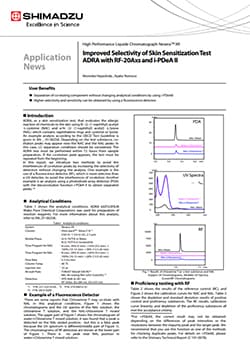
Improved Selectivity of Skin Sensitization Test ADRA withRF-20Axs and i-PDeAII
Accurate screening of ingredient reactivity is essential to ensure consumer protection while aligning with global shifts toward alternative, non-animal testing methods. This study uses an ADRA model with target compounds: N-(2-(1 naphthyl)acetyl)-L cysteine (NAC) and α N-(2-(1 naphthyl)acetyl)-L lysine (NAL), which simulate protein binding sites and enable evaluation of chemical reactivity associated with sensitization potential. The methodology employs the Amino Acid Derivative Reactivity Assay (ADRA), combined with fluorescence detection to improve analytical specificity. Measurements are performed using the Shimadzu Nexera™ HPLC system equipped with the RF 20Axs fluorescence detector and i-PDeA II deconvolution software, enabling highly sensitive detection of NAC and NAL depletion. This platform offers enhanced selectivity and sensitivity compared to conventional UV detection, enabling more accurate discrimination of reactive compounds and improving the reliability of high-throughput cosmetic safety assessments.
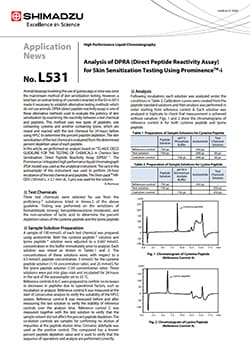
Analysis of DPRA (Direct Peptide Reactivity Assay) for Skin Sensitization Testing Using ProminenceTM-i
Identifying sensitization potential is critical for protecting consumers and meeting global regulatory expectations while reducing reliance on animal testing. We present a scientifically rigorous peptide-based screening approach focusing on cysteine- and lysine-containing synthetic peptides, which mimic protein binding sites targeted by sensitizing chemicals. These peptides are used to evaluate the interaction of test substances that may trigger allergic skin responses. The methodology utilizes the Direct Peptide Reactivity Assay (DPRA), in which test substances are incubated with peptide solutions and reactivity is quantified by measuring peptide depletion. Analysis is performed using high-performance liquid chromatography (HPLC) on the Shimadzu Prominence i system, with controlled injection, column temperature, and UV detection conditions to ensure precise, reproducible quantification of remaining peptide concentrations. Robust, standardized detection of peptide reactivity with high reproducibility, enables reliable, high-throughput screening of sensitization risk and supports confident, evidence-based cosmetic safety assessments.