


Analysis of Disinfection Byproducts (DBP) in Drinking Water

EPA sets enforceable rules for disinfectants and disinfectant byproducts (DBPs) in drinking water. DBP formation is influenced by precursor concentration and the type of disinfection used. For example, chlorination of water that is high in organic matter (TOC) may form trihalomethanes (THM) or haloacetic acids (HAA5), particularly in warmer temperatures. Other disinfectants, such as UV light or ozone, may create bromate (BrO3-) or chlorite (ClO2-). THM formation may be decreased by first adding ammonia prior to chlorine to form chloramines.
Depending on the treatment, chlorine, chloramines, bromate, chlorine dioxide and chlorite, TOC, THM, and HAA monitoring must be done. EPA has established residual goals for chlorine, chloramines, and chlorine dioxide and Maximum Contaminant Levels (MCLs) for total THMs, HAA, BrO3- for plants that use ozone, and ClO2- for plants that use chlorine dioxide. Some states, such as CA, have also established limits for nitrosamines.
TOC is not regulated; however, TOC must be removed below certain concentrations dependent upon source water alkalinity. Removal of TOC helps to minimize THM formation.
Approved Methods
| Chlorine Dioxide CLO2 | SM 4500-CLO2 | UV-1900i Plus or UV-1280 |
|---|---|---|
| Chlorine | SM 4500-Cl | UV-1900i Plus or UV-1280 |
| Bromate and Chlorite, Inorganic anions | EPA Method 300.1 | Ion Chromatograph |
| HAA5 | EPA Method 557 | LCMS-8060RX |
| EPA Method 552.3 | GC-ECD | |
| THMs | EPA Method 524.2 | GCMS with P&T |
| TOC | SM 5310B or D | TOC-L or TOCVW |
| UV-254 | SM 5910 B | UV-1900i Plus or UV-1280 |
Featured Applications
Determination of N-Nitrosamines by USEPA Method 521 using Triple Quadrupole Gas Chromatography Mass Spectrometry
The objective of this poster was to develop a simpler determination step than that described in the existing EPA 521 method and the various other N-nitrosamine experiments reported elsewhere2,3. Because Method 521 is a drinking water method, there is very little modification allowed. Even though Section 6.11.3 of the method states: “The tandem mass spectrometer may be either a triple quadrupole or an ion trap”, the same section also states “during the method development, only ion trap spectrometers were used”. Changing a detector is not allowed unless there is sufficient data to support the change. Unlike the flexibility allowed with 40 CFR Part 136.6 for wastewater, modifications of drinking water methods must go through a full ATP evaluation; since drinking water regulations are national standards, single laboratory validations are not permitted3 . This poster demonstrates a “proof of concept” and demonstrates that the triple quadrupole MS/MS detection technique provides data that are as “equally effective” as tandem ion trap MS/MS.
Determination of Haloacetic Acids (HAA5 and HAA9) in Drinking Water According to EPA Method 552.3
Haloacetic acids (HAAs) are known carcinogens that may occur as disinfection byproducts in drinking water. Currently, five HAAs are regulated under the Stage 2 Disinfectants and Disinfection Byproducts Rule (DBPR) and occurrence of four more HAAs is being monitored under the Unregulated Contaminant Rule 4 (2018-2020) 1 . EPA method 552.3 2 is approved for the monitoring of the regulated HAAs (HAA5), the additional four HAAs (HAA9) and dalapon. This publication demonstrates the performance of the Shimadzu Nexis GC-2030 with dual ECD, equipped with ClickTek technology, for the analysis of the ten target compounds included in EPA method 552.3 using helium as carrier gas. Precision was under 11% and accuracy ranged between 78-110% of expected values, meeting and exceeding the quality assurance criteria outlined in EPA method 552.3.
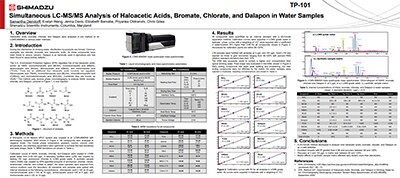
Simultaneous LC-MS/MS Analysis of Haloacetic Acids, Bromate, Chlorate, and Dalapon in Water Samples
During the disinfection of drinking water, disinfection by-products are formed. Common examples are chlorate, bromate, and haloacetic acids. All these compounds have been linked to various cancers. Dalapon is an herbicide used in agriculture and has been found to cause kidney defects. The U.S. Environment Protection Agency (EPA) regulates five of the haloacetic acids, known as HAA5: monochloroacetic acid (MCAA), monobromoacetic acid (MBAA), dichloroacetic acid (DCAA), dibromoacetic acid (DBAA), and trichloroacetic acid (TCAA). There are an additional four haloacetic acids currently not regulated: tribromoacetic acid (TBAA), bromochloroacetic acid (BCAA), chlorodibromoacetic acid (CDBAA), and bromodichloroacetic acid (BDCAA). Combined they are known as HAA9. 2 This method uses reverse phase chromatography to analyze HAA9, bromate, chlorate, and Dalapon, pictured in Figure 1, in one injection
TOC Application Handbook
This handbook describes includes over 50 TOC (Total Organic Carbon) application notes covering environmental, pharmaceutical, chemical, agricultural applications.
TOC Analysis for Standard Methods 5310B: High-Temperature Combustion Method
Total Organic Carbon (TOC) is a rapid method that analyzes for organic carbon and expresses the result as the amount of carbon found. It is a non-specific method unable to distinguish between various organic species and only indicates that organic carbon compounds are present. Organic carbon analyzers operate by the determination of the amount of total carbon present in a sample aliquot. Total carbon consists of inorganic and organic carbon. The inorganic carbon, present as carbonate or bicarbonate ions, must be removed or quantified prior to the analysis of organic carbon. Once the inorganic carbon is removed, subsequent analysis of the sample aliquot assumes that all carbon remaining is organic.