


Analysis of VOCs & SVOCs in Drinking Water

Organic chemical method requirements for drinking water testing in the United States are found at 40 CFR Part 141.24. EPA has established MCLs for primary contaminants including Volatile Organic Compounds (VOCs), Semi volatile Compounds (SOCs), and various herbicides and pesticides. EPA has published standardized methods gas chromatography mass spectrometry (GCMS) Method 524.2 and Method 525.2 for the analysis of VOCs and SOCs respectively. EPA has also approved numerous methods through the expedited process. These methods are found at 40 CFR Part 141 Subpart C Appendix A and include Method 524.3, 524.4, and 525.3. Using these newer methods can decrease costs and improve quality control and long-term stability of your instrument.
Related Products
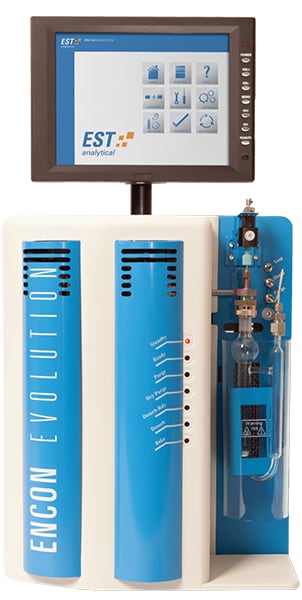
Purge and Trap Concentrator Sampler
As detection limits have been pushed lower, and mass spectrometer systems more sensitive, a reliable purge and trap sampler has never been more important when analyzing for VOCs. This P&T comes equipped with everything you need to perform your environmental applications.
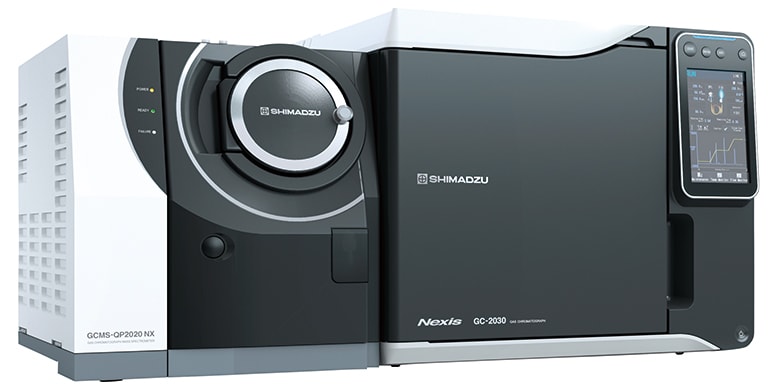
GCMS-QP2020 NX Single Quadrupole GC-MS
GC/MS is now a standard analytical technique used in a variety of fields. With each new development, requests for more cost-effective systems and improvements in the work-life balance of users grow. Dedicated to improving efficiency, the GCMS-QP2020NX can assist any laboratory, regardless of its analysis focus, achieve its full potential.
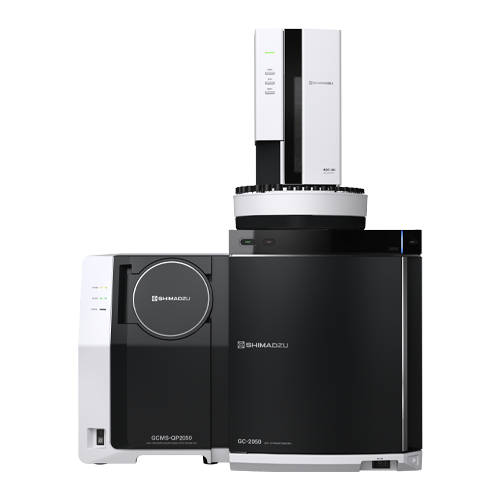
GCMS-QP2050 Single Quadrupole GC-MS
The GCMS-QP2050 with the new DuraEase ion source maximizes uptime and sensitivity while requiring minimum maintenance, which can be completed in just a few minutes and a few simple steps. New cost-effective ion source design allows customers to replace DuraEase source when needed, maintaining pristine condition. The built-in pre-rod allows only the ions to efficiently pass through, limiting contamination of the quadrupole.
Featured Applications
Shimadzu Guide to US EPA Methods 524.3 and 524.4 for Analysis of Volatile Organic Compounds in Drinking Water
Due to advances in analytical instrumentation the United States Environmental Protection Agency (US EPA) introduced a new drinking water method in June 2009. US EPA Method 524.3 allows laboratories to modify purge and trap and GCMS conditions in order to accommodate instrumental advances and shorten sample preparation time. The US EPA also investigated the option of using nitrogen as the purge gas in an additional drinking water method, US EPA Method 524.4 . This application note will compare analytical results when using helium and nitrogen purge gases.
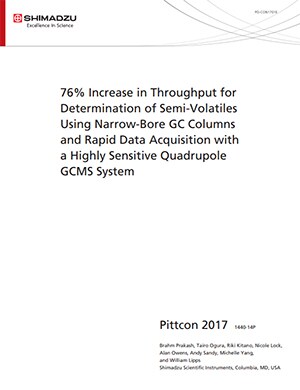
76% Increase in Throughput for Determination of Semi-Volatiles Using Narrow-Bore GC Columns and Rapid Data Acquisition with a Highly Sensitive Quadrupole GCMS System
Laboratories analyzing semi-volatile organics by methods such as Method 625 and Method 8270 typically use 0.25 mm ID capillary columns. Depending on method conditions, simply running the required quality control (QC) samples can consume a significant portion of a 12-hour shift, leaving less time for analysis of revenue-generating samples. A cycle time for a single injection on a standard single quadrupole Gas Chromatograph Mass Spectrometer (GCMS) may be as long as 30 minutes. Thus, in a 12-hour tune cycle with QC, including a continuing calibration verification (CCV), method blank (MB), laboratory control sample (LCS), laboratory control sample duplicate (LCSD), matrix spike (MS), and a matrix spike duplicate (MSD), per analytical batch you may only have time for 18 actual samples before having to verify the tune. Fast GC uses narrow bore (0.15mm ID) columns, rapid oven heating and cooling, and rapid data acquisition to decrease runtime. A sensitive quadrupole mass spectrometer is necessary for identification and quantitation of target compounds at sub-nanogram levels. In addition, fast mass-spectral scanning and data acquisition is required because of the very narrow chromatographic peaks produced under these conditions. The Shimadzu GCMS-QP2020 is a new, sensitive, fast-scanning single quadrupole GCMS system capable of significantly reducing the run time for EPA methods 625 and 8270.
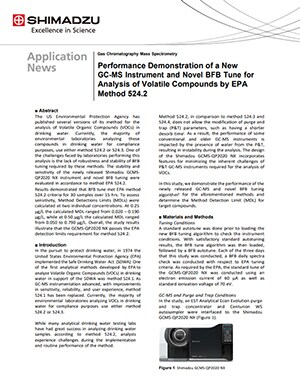
Performance Demonstration of a New GC-MS Instrument and Novel BFB Tune for Analysis of Volatile Compounds by EPA Method 524.2
The stability and sensitivity of the newly released Shimadzu GCMSQP2020 NX instrument and novel BFB tuning were evaluated in accordance to method EPA 524.2. Results demonstrated that BFB tune met EPA method 524.2 criteria for 30 samples over 15 hrs. To assess sensitivity, Method Detections Limits (MDLs) were calculated at two individual concentrations. At 0.25 µg/L the calculated MDL ranged from 0.020 – 0.190 µg/L, while at 0.50 µg/L the calculated MDL ranged from 0.050 to 0.790 µg/L. Overall, the study results illustrate that the GCMS-QP2020 NX passes the EPA detection limits requirement for method 524.2.
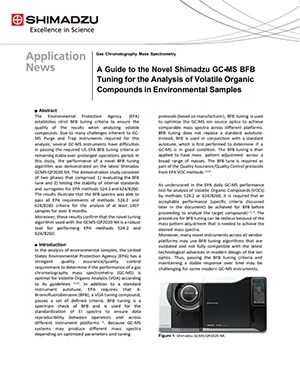
A Guide to the Novel Shimadzu GC-MS BFB Tuning for the Analysis of Volatile Organic Compounds in Environmental Samples
The Environmental Protection Agency (EPA) establishes strict BFB tuning criteria to ensure the quality of the results when analyzing volatile compounds. Due to many challenges inherent to GCMS Purge and Trap instruments required for this analysis, several GC-MS instruments have difficulties in passing the required US EPA BFB tuning criteria or remaining stable over prolonged operations period. In this study, the performance of a novel BFB tuning algorithm was demonstrated on the latest Shimadzu GCMS-QP2020 NX. The demonstration study consisted of two phases that comprised 1) evaluating the BFB tune and 2) testing the stability of internal standards and surrogates for EPA methods 524.2 and 624/8260. The results illustrate that the BFB spectra was able to pass all EPA requirements of methods 524.2 and 624/8260 criteria for the analysis of at least 1407 samples for over 4 months.