


Conventional Pollutants / Wet Chemistry Analysis of Wastewater
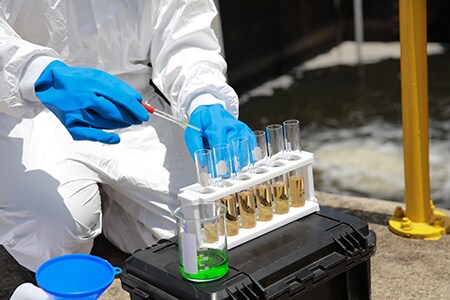
Conventional pollutants and nutrients, such as nitrate, nitrite, ammonia, phosphate, total phosphorus, total nitrogen, cyanide and phenolics are named in many general permits and may be measured by visible spectrometry or ion chromatography. Nutrient analysis may also include Total Organic Carbon (TOC) which can be used as a surrogate for Biochemical Oxygen Demand (BOD) or Chemical Oxygen Demand (COD) with faster results and less waste. Methods approved for NPDES or numeric water criteria monitoring of ambient water are found at 40 CFR Part 136.3. Methods that can be used with Shimadzu instruments are found here.
Total Organic Carbon (TOC)
Total organic carbon (TOC) is a rapid is a nonspecific method unable to distinguish between various organic species and indicates only that organic carbon compounds are present. TOC analyzers operate by determining the amount of total carbon in a sample aliquot. Total carbon consists of inorganic and organic carbon. Inorganic carbon, present as carbonate or bicarbonate ions, must be removed or quantified prior to the analysis of organic carbon. Once the inorganic carbon is removed, subsequent analysis of the sample aliquot assumes that all carbon remaining is organic.
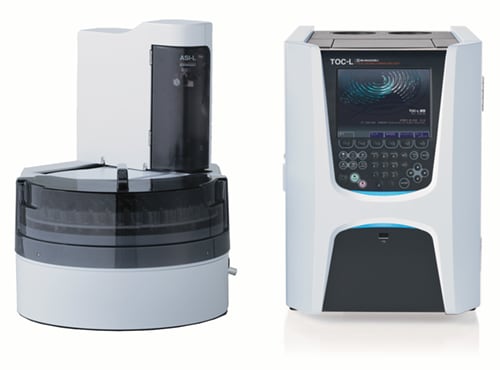
TOC-L Series Total Organic Carbon Analyzer
Standard Methods 5310B is a high-temperature catalytic oxidation (HTCO) method for the analysis of TOC by direct injection of sample into a 680 ºC furnace containing a platinum catalyst. The Shimadzu TOC-L HTCO TOC analyzer is rapid and precise, and capable of determining TOC in wastewater samples with high dissolved solids and suspended solid concentrations. Accessories are available to assist in analysis of samples with very high suspended solids, or very high dissolved solids.
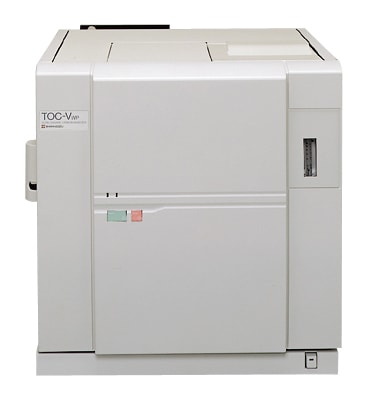
TOC-V Series Wet Oxidation TOC Analyzer
The persulfate digestion method, Standard Methods 5310C is catalyzed by heat, UV light, or both and capable of digesting large samples sizes (~ 20 ml) resulting in detection limits as low as 2 ppb, depending on contamination. The Shimadzu TOC-VWP is based on this technology. Use this instrument for precise measurement of low TOC concentrations in wastewater containing minimal dissolved or suspended solids.
Total Nitrogen (TN)
Total Nitrogen (TN) is not currently regulated or included as a test parameter at 40 CFR Part 136, however, total nitrogen is monitored for percentage of nitrogen removal during the wastewater treatment process, and in determining ambient water quality. Unfortunately, because EPA does not have a parameter or method for TN alone, laboratories must analyze both Total Kjeldahl Nitrogen (TKN) and Nitrate Nitrogen and calculate the sum to estimate TN. Fortunately, Shimadzu has collaborated with ASTM and with Standard Methods to develop methods specific for TN.
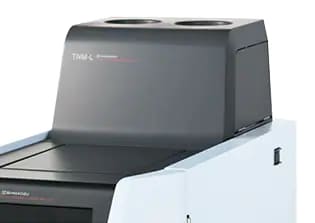
TOC-L Series Total Organic Carbon Analyzer with Total Nitrogen Unit
Two TN methods, ASTM D8083- and Standard Methods 4500-N E for Total Nitrogen couple the Shimadzu TOC-L with a chemiluminescent nitrogen detector. These methods are also capable of simultaneous analysis of TOC. Of Course, if TKN is needed you can subtract nitrate-nitrogen from the TN result.
Conventional Pollutants
Conventional pollutants and nutrients, such as nitrate, nitrite, ammonia, phosphate, total phosphorus, total nitrogen, cyanide and phenolics are named in many general permits and may be measured by visible spectrometry or ion chromatography.
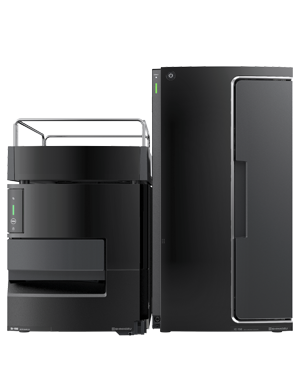
Nexera IC Ion Chromatograph
Inorganic anions, such as chloride, nitrite, bromide, nitrate, phosphate, and sulfate may be measured by the Shimadzu Nexera IC Ion Chromatograph using EPA Method 300 or 300.1, ASTM D4327, or Standard Methods 4110B. Ammonium ions and cations may be measured on the IC by ASTM D6919, and total nitrogen and total phosphorus may be measured simultaneously on the IC by ASTM D8001. Use the Shimadzu 1280 or the UV-1900i for conventional pollutants, such as ammonia nitrogen, nitrate and nitrite nitrogen, phosphate and total phosphorus, cyanides, and total phenolics. The Nexera IC features automatic eluent generation, automatic standard curve preparation, and automatic dilution of off scale peaks to save you time and minimize analyst errors.
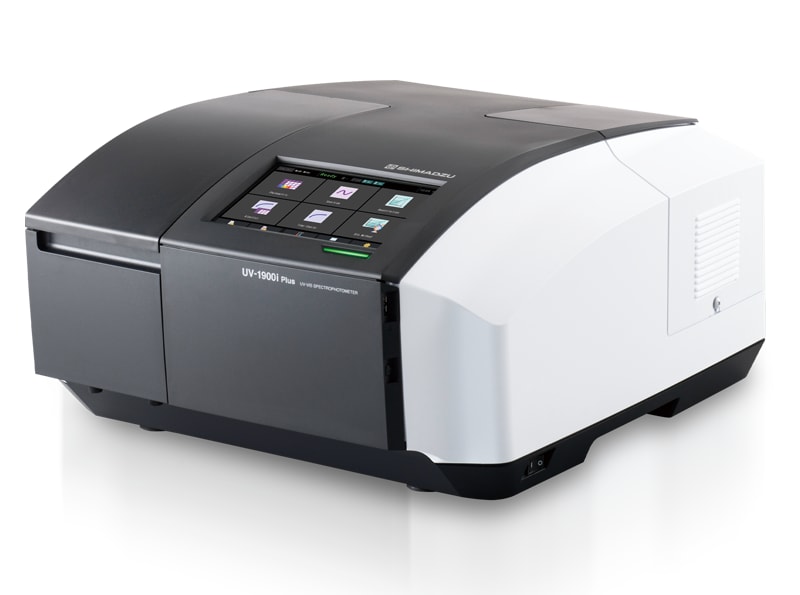
UV-VIS Spectrophotometers
Use the Shimadzu UV-1280 or the UV-1900i Plus for conventional pollutants, such as ammonia nitrogen, nitrate and nitrite nitrogen, phosphate and total phosphorus, cyanides, and total phenolics.